AI Trading Journal
Last Updated:
November 4, 2026


AI Trading Journal: What an AI Agent Adds to Trade Review
A guide to what an AI agent can find in your trade record, how to choose one, what to log for it and how to ask questions that change the way you trade.
An AI trading journal is a trade journal with an AI agent that reads your own executions and stats, points out the patterns behind your results and suggests what to test next. The Deepvue Trading Journal comes with a Journal Agent is included in Deepvue’s one plan, and the Black Friday deal cuts the annual price to $490, less than half the regular rate, locked in for as long as you stay.
During the Deepvue Trading Journal launch webinar, hundreds of traders answered two polls. Ninety nine percent said journaling helps their trading. Asked whether they review their trades regularly, about 20 percent said yes, and the rest admitted they don’t do it as often as they should.
Never miss a Deepvue blog post.
That gap is the whole case for an AI trading journal. Logging trades has been automatic for years, since broker sync does it for you. The review is the part that still takes a quiet hour, a clear head and the willingness to look at your own mistakes.
We built a Journal Agent into the Deepvue Trading Journal to take that first pass for you. Whichever tool you end up with, though, the same things decide whether an AI review changes your trading: what you record, how you ask and how you test what it finds.
Key Takeaways
– An AI trading journal adds an agent that reads your own executions and stats, then explains the patterns behind the numbers and suggests what to test next. It never predicts prices.
– Choose a journal whose AI reads your own trades, keeps your data anonymized with zero retention, isn’t tightly metered and covers the markets you trade.
– Record a stop, a setup and a plan note on every trade, then ask specific questions with a time frame and a metric, and test one change at a time.
– The Deepvue Journal Agent answers suggested reviews or any question by voice or keyboard, and the AI Terminal takes the findings into research, both in one plan.
– Lock in $490 a year by December 4, and sign up by November 12 to get the two live masterclasses free.
What Is an AI Trading Journal?
An AI trading journal is journal software that pairs your trade record with an AI agent that can read it. The journal still does the base work: it syncs your executions, groups them into positions, scores them in dollars, percent and R, and sorts results by setup, tag or emotion.
The AI layer sits on top of that record. Ask it a question and it reads your stats and executions, then answers in plain language: what it sees, where the biggest opportunity is and what to try next. That’s a trading journal with AI insights rather than one more chart to interpret.
That distinction is important, because plenty of tools now describe a chatbot as AI. A chatbot that hasn’t seen your trades can only give generic advice. A journal agent that has seen them can tell you that your stops are missing on half of last month’s entries, and name the trades.
| Job | A standard trading journal | A trading journal with AI |
|---|---|---|
| Logging trades | Broker sync or CSV import fills the record | Same record, same sync |
| Scoring | Win rate, profit factor, expectancy, R, MFE and MAE on a dashboard | Same stats, plus a plain language reading of what they mean together |
| Finding patterns | You filter by setup, tag or weekday and compare | The agent scans the whole record and names the leaks it sees |
| Deciding what to change | You pick an experiment from the stats | The agent proposes one, sized to your sample |
| Data gaps | Missing stops and tags show as blanks | The agent calls them out and tells you what they cost your analysis |
| Predicting trades | No | Still no |
Three kinds of AI get mixed up in trading.
- •AI trading bots place orders.
- •An AI trading assistant like Deepvue’s AI Terminal answers research questions and builds screens.
- •An AI journal agent reviews what you already did.
Only the last one is the subject here, and it never touches an order.
Why Trade Review Is Where Most Journals Stall
The habits that cost traders money are well documented, and almost none of them show up in a single trade. They appear across dozens, which is the job a journal does.
| Study | What it found | What it means for your journal |
|---|---|---|
| Barber and Odean, 66,465 households (2000) | The most active traders earned 11.4% a year against 18.5% for the least active | Track how often you trade and what each extra trade earns |
| Odean, 10,000 accounts (1998) | Investors sold winners more readily than losers, and the losers they kept underperformed | Compare holding time and R on your winners and your losers |
| Lo, Repin and Steenbarger, 80 day traders (2005) | Traders with stronger emotional reactions to gains and losses performed significantly worse | Tag the emotion at entry and check what each one costs |
| Biais and Weber, 85 investment bankers (2009) | The more hindsight biased bankers performed worse | Write the plan before the entry, so the review can’t rewrite it |
| Di Stefano, Gino, Pisano and Staats, Harvard Business School (2014) | Fifteen minutes of daily written reflection lifted final test scores 22.8% | Review on a schedule, even briefly |
The catch is that the review still has to happen, and the launch poll showed how rarely it does. Most traders have the data and skip the sitting down.
An AI trading journal cuts the first pass to one click. A review that takes seconds gets done on a Sunday night far more often than a blank page does, and once it’s done, the next step is usually obvious.
BLACK FRIDAY
Try a One Click Review on Your Own Trades A full year of Deepvue, journal and AI included, for $490 instead of $990.
What an AI Agent Can Spot in Your Trade Record
A dashboard shows each number on its own. AI trade analysis reads them together, and that’s where most of its value comes from. A good journal agent should surface findings like these, each with an obvious next step.
| Finding | What it looks like in your record | What to do next |
|---|---|---|
| Missing risk data | Trades logged without a stop or initial risk, so R and risk consistency can’t be measured | Add stops to past trades and record risk before every new entry |
| Exits giving back gains | Low exit efficiency or MFE capture: trades moved your way further than you kept | Log the exit reason and compare it with the plan before you try holding longer |
| A win rate hiding weak results | A high win rate next to thin expectancy, or two figures that should agree and don’t | Reconcile the numbers, then judge by expectancy and R |
| Setups that don’t pay | One playbook or tag with negative expectancy across a decent sample | Cut size on it or pause it while you test a fix |
| Inconsistent risk | Losses of very different sizes in R | Size every entry from the stop and a fixed dollar risk |
| A sample too small to trust | A pattern built on a handful of trades | Keep logging and ask the same question again later |
The best agents also say what they can’t conclude. A review that ends with “the sample is small” or “excursion data is incomplete” is worth more than a confident answer built on missing fields.
What to Record So the AI Has Something to Read
An AI review is only as good as the record under it. Broker sync takes care of the fills. The rest depends on a few fields you fill in yourself, and each one opens up a different kind of answer.
| Field | What it adds to a review | What you lose without it |
|---|---|---|
| Stop or initial risk | Every trade scored in R, plus a read on risk consistency and exits | R, expectancy in R and any judgment on sizing |
| Setup or playbook | Win rate, expectancy and R compared by setup | Any answer to which setup actually works |
| Plan note before entry | A check of each trade against what you intended | Your defense against hindsight bias |
| Exit reason | Planned exits separated from early or emotional ones | The why behind a low exit efficiency |
| Emotion at entry | What each state costs you across many trades | The link between mood and results |
| Consistent tag names | Like trades grouped together | Clean comparisons, since “breakout” and “BO” count as two setups |
Consistency beats detail. Five fields filled in on every trade will tell you more than twenty filled in on a few, and they take about a minute per trade once they’re a habit.
How to Choose the Best AI Trading Journal
Most journals now advertise AI, and the label covers very different things. The questions below separate a useful agent from a chatbot bolted onto a dashboard.
Seven Questions to Ask Before You Subscribe
| Question | Why it matters | What a good answer looks like |
|---|---|---|
| Does the AI read my own trades? | A chatbot without your record can only give generic advice | It reviews your synced stats and executions on request |
| What data reaches the AI, and is it kept? | Your trade history is financial data | Anonymized numbers, no names or account details, zero data retention |
| Is the AI metered? | Credits and daily caps decide how often you’ll actually use it | Usage included in the plan, or a cap you won’t hit in a normal week |
| Does my broker sync automatically? | The AI can only review trades that made it into the journal | Automatic sync for your broker, plus CSV import for the rest |
| Does it cover the markets I trade? | Unsupported products drop out of the record and skew the stats | Every asset class you trade, in your account currency |
| Can I use it on my phone? | Reviews happen when you have ten spare minutes, often away from a desk | Native iOS and Android apps with the full journal |
| Does it connect to my research? | A finding needs somewhere to go next | Screens, charts and watchlists in the same account |
Red Flags in Any AI Trading Tool
- •It promises returns or predicts prices. FINRA warns investors to be wary of claims that AI can guarantee amazing investment returns, and notes that AI generated information might rely on data that is inaccurate, incomplete or misleading.
- •It asks for your broker password. A sound integration sends you to the broker’s own site to approve the connection.
- •It can’t say what happens to your data. With no published retention policy, assume your trades are kept.
- •It places trades for you. That’s a trading bot, a different product with different risks.
- •Every answer sounds certain. An agent that never mentions sample size or missing fields is guessing.
The markets question is where we’d point you elsewhere: the Deepvue Trading Journal covers stocks in USD and CAD accounts, so it isn’t the right pick if you journal futures, forex or options. For stock traders, it was built around every other answer in that table.
To see those questions applied to named tools, our roundups of TradeZella alternatives and Tradervue alternatives compare the main journals on broker sync, AI, mobile apps and price.
Inside the Deepvue Journal Agent
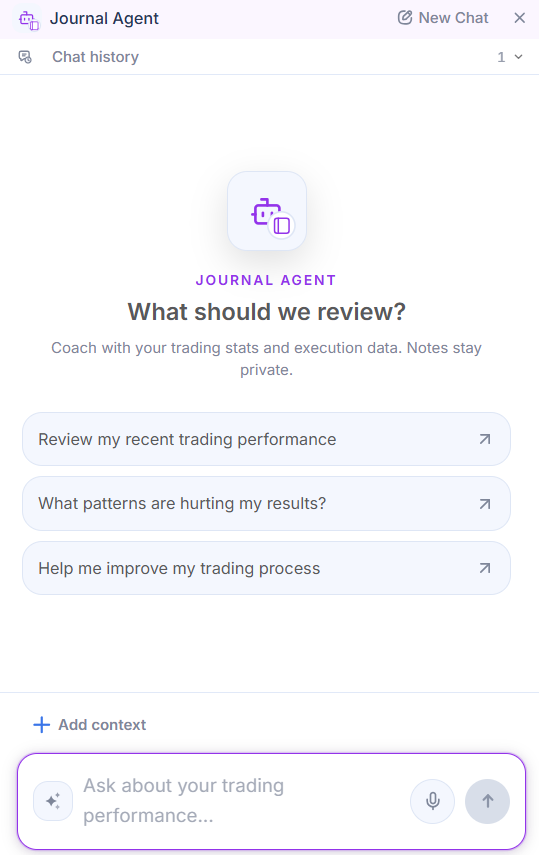
The Journal Agent opens in a panel beside your journal, on desktop and mobile. It coaches from your trading stats and execution data, keeps your notes private, and starts with a few one click review prompts plus a box for your own questions, typed or spoken.
One Click Reviews
Each suggested prompt reads your record from a different angle, and every answer comes back in labeled parts, so what the agent observed stays separate from what it suggests.
| Prompt | What it looks at | What you get back |
|---|---|---|
| Review my recent trading performance | Headline results, data quality and the biggest gap in your process | What it observed, the process opportunity it sees and a short list of things to try next |
| What patterns are hurting my results? | Leaks in exits, risk control and how your results hang together | The main leaks, each with its evidence and how much weight it deserves |
| Help me improve my trading process | Whether good results are repeatable | Experiments to run over your next batch of trades |
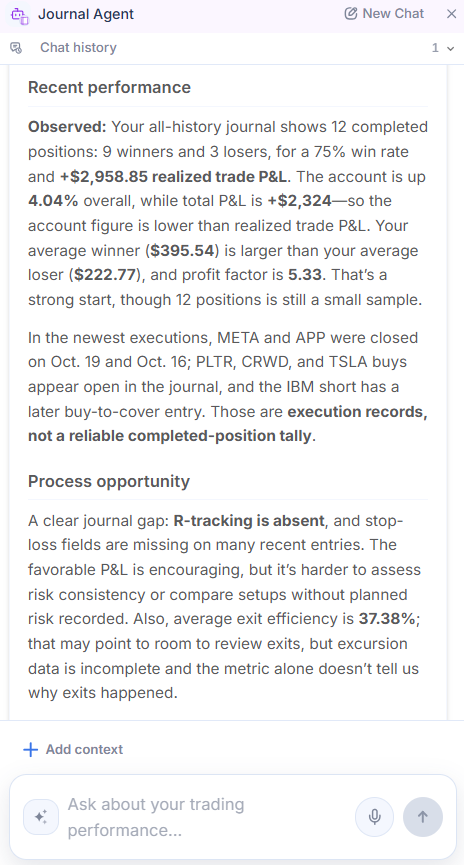
On a small sample journal we tested, the first review caught a mismatch between realized trade P&L and the account’s overall change, and noted that many recent entries had no stop. That cross check is the kind of AI trading analysis a human reviewer often skips.
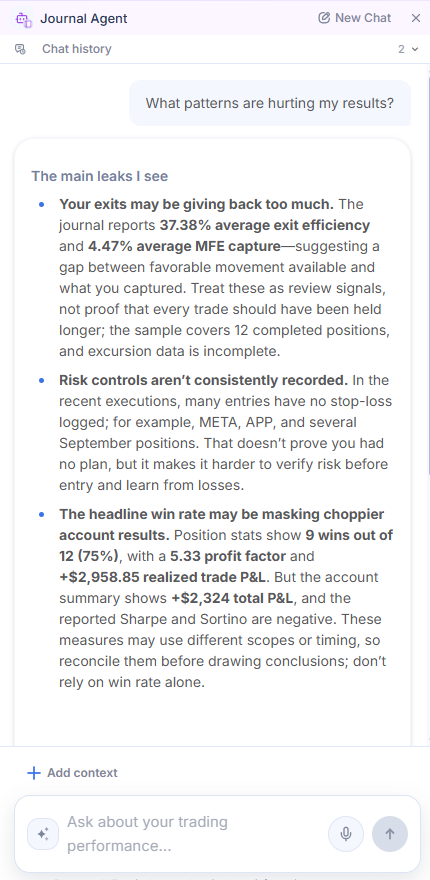
None of it is a prediction, a price target or a buy call. It’s an AI trading coach reading your process the way an AI trading mentor would, with the advantage that it has read every execution rather than the few you remember.
Ask Your Own Question, by Voice or Keyboard
Past the suggested prompts, the box at the bottom takes any question about your trading. Tap the microphone to talk instead of typing, use Add context to bring more information into the question, and open Chat history to revisit earlier reviews.
The agent shares a Prompt Library with the rest of Deepvue AI, with tabs for your own and imported prompts plus market, theme, stock and earnings questions. The stock prompts help when a review surfaces a symbol you want to understand before trading it again.
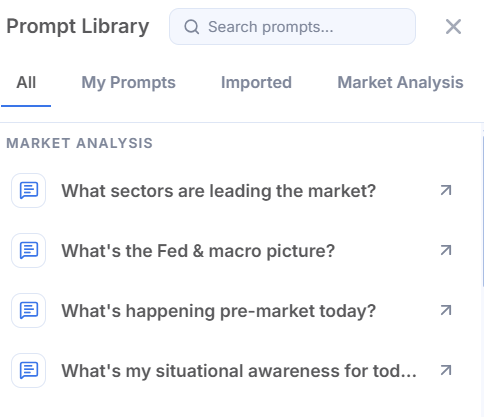
Every answer draws on the same Dashboard and Trades tab you can open yourself, and the journal features guide covers each Dashboard app. Deepvue’s launch webinar tours both and reviews a trade end to end, so you can see what the agent is reading.
BLACK FRIDAY
Put These Questions to Your Own Record Join by November 12 and two live masterclasses come free with your $490 Black Friday year.
How to Use the Deepvue Journal Agent for the Best Results
The agent works with whatever your journal holds, so a little setup before the first review pays off in every answer after it.
Watch the Deepvue Trading Journal launch walkthrough here.
Before Your First Review
- •Connect your broker. Most first syncs finish within a day and IBKR within two, and a CSV in any layout covers anything else. The supported brokers list shows what connects.
- •Add stops to past trades. Filter the Trades tab to Needs Stop and fill in the stop you used. Without it the agent can’t score R or judge your risk.
- •Name your playbooks once. Give each setup one consistent name so the agent can compare them.
- •Clear To Review. Add an emotion and a lesson note to each trade, then hit Save and next. Your notes stay private, and the tags feed the stats the agent reads.
Run the Suggested Reviews in Order
Start with performance, then patterns, then process. In each answer, read the process opportunity before anything else, because that’s where gaps in your record show up. Fix those gaps first, since every later answer depends on them.
Questions Worth Asking the Agent
Once the basics are in place, specific questions get specific answers. Each of these maps onto data the journal already tracks:
| When you want to know | Try asking |
|---|---|
| Which setup to lean on | “Which playbook has the best expectancy in R over my last 30 closed trades?” |
| Where losses come from | “Do my biggest losers share a tag, a symbol or a day of the week?” |
| Whether exits cost you | “Which trades captured the least of their favorable move, and what do they have in common?” |
| Whether risk is consistent | “How much does my loss size vary in R, and which trades were outside my normal risk?” |
| Whether a change worked | “Compare my expectancy and win rate this month with last month.” |
| Where the record is thin | “Which closed trades are missing a stop or a playbook?” |
Get More From Every Answer
- •Ask it to name the trades. A pattern you can open on the chart is a pattern you can check.
- •Ask for counterexamples. “Which trades don’t fit this pattern?” keeps one bad week from becoming a rule.
- •Use the suggested follow ups. They appear under the latest answer and turn a symbol into a research question, such as its recent catalysts or closest competitors.
- •Debrief by voice. Talk through the session right after the close, while the details are fresh.
- •Write your own lesson first. Note what you think went wrong, then ask. Where the agent disagrees is where the learning is.
- •Repeat the same question later. Chat history keeps earlier answers, so this month’s review sits next to last month’s.
A 20 Minute Weekly Routine
- •Let the sync run. Your week’s fills arrive on their own.
- •Clear Needs Stop and To Review. Two filters, a few minutes.
- •Run the three suggested reviews. Performance, patterns, process.
- •Pick one experiment. Commit to it for your next 10 completed positions.
- •Size the next entries. The Position Size Calculator, one of Deepvue’s trading tools, turns your stop and dollar risk into a share count, and the Open Risk app totals the heat you’re carrying.
- •Ask again after 10 trades. Compare expectancy by setup, not the win rate.
Run Your First Review on Your Phone Tonight
Open the Black Friday offer from your phone, pay $490 for the year rather than $990, then grab the Deepvue app for iOS or Android, connect a broker and ask the agent what it sees.
How the Journal Agent Keeps Your Data Private
Pasting a broker statement into a general chatbot means handing a third party your account details, your notes and your names, often with no promise about what happens to them afterward. The Journal Agent was designed so you never make that trade.
- •Opt in only. Nothing is sent to any AI until you open the agent and ask. Skip it and no trade data leaves the journal.
- •Anonymized by design. What reaches the AI is numbers and symbols. No name, no account details, and your notes never leave the journal.
- •Zero data retention. The AI provider Deepvue uses runs under a zero retention policy, so nothing you send is stored or used for training.
- •No broker credentials involved. You connect your broker on the broker’s own site, and Deepvue never sees your password.
That design answers the question behind searches like is AI trading legit. The legitimacy problem is usually the data flow, not the model. An agent that reads anonymized numbers and keeps nothing is a different proposition from an unknown app asking for your login.
How to Get Reliable Answers From Any AI Trading Journal
Whatever journal you use, the same habits separate an AI review that changes your trading from one you read and forget.
Swap Vague Questions for Specific Ones
| Vague | Specific |
|---|---|
| “How can I be more profitable?” | “Which setup has the worst expectancy in R over my last 30 trades?” |
| “Am I a good trader?” | “How did my average loss in R change after I started using hard stops?” |
| “What stock should I buy?” | “Which of my closed trades broke my own risk rules?” |
| “Why did I lose money?” | “Do my losing trades share an entry time, a tag or a holding period?” |
A question with a time frame, a metric and a comparison gives the AI something to measure. A question about the future gives it nothing to work with.
Make It Show the Evidence
Ask the agent to name the trades behind any pattern and to separate what the data shows from what it suspects. Then open a few of those trades yourself before you act.
Research on AI at work shows why. In a Harvard field experiment with 758 Boston Consulting Group consultants, AI users finished 12.2 percent more tasks, 25.1 percent faster, when the task suited the tool, and were 19 percent less likely to get the answer right when it didn’t.
Separate a Pattern From Noise
Small samples produce convincing stories. Before building a rule on a finding, we’d want to see it hold across at least 20 to 30 trades of the same setup, and to run three quick checks:
- •Judge by expectancy and R. A high win rate with small winners can still lose money.
- •Look for one outlier. If a single trade carries the result, it isn’t a pattern yet.
- •Check another period. A finding that holds in two different months is worth more than one that appears once.
Change One Thing at a Time
Pick one suggestion, apply it for a set number of trades, then ask the same question again. Change three rules at once and you won’t know which one helped, or which one hurt.
Turn Every Review Into Your Next Setup
An AI trading journal earns its place when it turns your own record into one clear change, then sends you back to the market with it. The Journal Agent finds where your trades leak, and the rest of Deepvue picks up the research.
Study the setup on Deepvue charts, see why the session’s Top Movers moved, check earnings and sales history in the Stats Table and set price alerts on your levels.
BLACK FRIDAY DEAL
Let an Agent Read Your Trades for $490 a Year
Run the suggested reviews on your own trades, then take the findings into the AI Terminal to research what’s next, on desktop and mobile, for $490 a year rather than $990. Renewals hold at $490 while you stay subscribed.
$990 $490 a year, locked in
Frequently Asked Questions
Is an AI trading journal worth it?
An AI trading journal is worth it if you have trades to review and keep skipping the review. The best AI trading journal does the first pass in seconds, names the trades behind each pattern and flags gaps like missing stops. It’s part of the single Deepvue plan, and Black Friday pricing holds a full year at $490 rather than $990.
What is the best AI trading journal?
The best AI trading journal is one whose agent reads your own trades, keeps your data anonymized and comes included in the plan. For stock traders, that’s the Deepvue Trading Journal: its Journal Agent is opt in, sees only numbers and symbols, and shares one plan with the AI Terminal, $490 a year with the Black Friday deal.
How do I use AI for trading?
You actually use AI for trading by giving it the two jobs it does well, which is the practical answer to how to use AI for trading: reading your own record and compressing research. In Deepvue, the Journal Agent reviews your executions and stats, and the AI Terminal answers stock questions and builds screens. Neither one places orders, and every decision stays yours.
Can I use ChatGPT as a trading journal?
You can use ChatGPT as a trading journal only in a limited way. Pasting trades in works for notes, but it won’t sync your broker, calculate R or keep a record you can filter, and your statement becomes someone else’s data. A journal agent built into the journal sees anonymized numbers only, keeps your notes private and works from a record that updates itself after every sync.
Is AI trading legit?
AI trading is legit when the AI analyzes rather than promises. Tools that claim to predict prices or guarantee returns are the ones regulators warn about, and FINRA cautions that chatbot conversations can push people into impulsive decisions. The Deepvue Journal Agent reviews your past trades, sees no names or account details and never routes an order.
What data does the Journal Agent see?
The Journal Agent sees your trading stats and execution data, passed along as anonymized numbers and symbols. No name or account details go with them, and your notes stay private. It’s opt in, so nothing is sent until you ask a question, and Deepvue’s AI provider keeps no data under a zero retention policy.
What is the difference between the Journal Agent and the AI Terminal?
The difference between the Journal Agent and the AI Terminal is what each one reads. The Journal Agent reviews trades you’ve already taken, using your journal’s stats and executions. The AI Terminal is Deepvue’s research assistant: it answers stock and theme questions, reads the watchlists and screens you tag with @, and builds screens from plain English. Both come in the same plan.
What is the best app for a trading journal?
The best app for a trading journal syncs your broker, scores every trade in R and reviews the record for you, on your phone as well as your desktop. The Deepvue Trading Journal app does all three on iOS and Android, with the Journal Agent included, and the setup guide walks through connecting a broker step by step.
Sources
- •Barber, B. M. and Odean, T. (2000). Trading Is Hazardous to Your Wealth: The Common Stock Investment Performance of Individual Investors. The Journal of Finance, 55(2). UC Berkeley Haas faculty copy.
- •Odean, T. (1998). Are Investors Reluctant to Realize Their Losses? The Journal of Finance, 53(5). UC Berkeley Haas faculty copy.
- •Nobel, C. (2014). Reflecting on Work Improves Job Performance. Harvard Business School Working Knowledge, on Di Stefano, Gino, Pisano and Staats, Learning by Thinking, HBS Working Paper 14-093.
- •Lo, A. W., Repin, D. V. and Steenbarger, B. N. (2005). Fear and Greed in Financial Markets: A Clinical Study of Day-Traders. NBER Working Paper 11243, published in the American Economic Review, 95(2).
- •Biais, B. and Weber, M. (2009). Hindsight Bias, Risk Perception, and Investment Performance. Management Science, 55(6).
- •Dell’Acqua, F. et al. (2023). Navigating the Jagged Technological Frontier: Field Experimental Evidence of the Effects of Artificial Intelligence on Knowledge Worker Productivity and Quality. Harvard Business School Working Paper 24-013.
- •FINRA (2024). Artificial Intelligence (AI) and Investment Fraud. FINRA Investor Insights.