What Is a Trading Journal and Why Keep One?
Last Updated:
November 23, 2026


What Is a Trading Journal and Why Keep One?
A stock trader’s definition, plus the research on why a written record beats memory. BLACK FRIDAYClaim Black Friday Pricing →
A trading journal is your own record of each trade, plus the plan, reasoning and review behind it, kept so you can see which decisions make you money. In trading, a trade journal means that personal record, and it has nothing to do with the trade publications that cover an industry.
Most traders have a rule they break and no idea how often they break it. Moving a stop, sizing up after a hot streak, chasing a stock well past its buy point: each one feels like a single exception when it happens.
Never miss a Deepvue blog post.
A trading journal turns those exceptions into a count. The Deepvue Trading Journal brings in your executions automatically and gives you room to log the plan, the emotion and the lesson on every position. Then the pattern is in front of you properly recorded instead of in your memory.
Key Takeaways
- •A journal is more than a trade log. It records each trade plus the plan before entry and the review after exit, which a broker statement never holds.
- •Memory flatters your record. Investors in a PNAS study recalled their biggest trade’s return 4.3 percentage points higher than it was, and looking up the real numbers cut overconfidence and trading.
- •The habit takes about two months. A 2024 review of habit research found a median of 59 to 66 days to form one, with individual cases anywhere between 4 and 335 days.
- •A journal won’t find trades for you. It sharpens decisions only when you review it, and a handful of trades can point you the wrong way.
- •Start your record this week. Get Deepvue for $490 a year through December 4 and keep your journal on desktop and mobile.
What Is a Trading Journal?
A trading journal is a written record of every trade you take, along with why you took it and what you learned once it closed. For a stock trader holding weeks to months, each entry ties a position to its plan: the setup, the stop, the size and the reason the stock earned a spot in your account.
That’s the trading journal definition most traders work from. Libraries use the term trade journal for magazines that cover an industry, so what is a trade journal when traders say it? It’s the same thing as a trading journal, your own record of your own trades.
Trading Journal vs Broker Statement
Your broker already keeps a record, so it’s fair to ask what a journal adds. The statement shows what happened. The journal shows what you meant to do, and whether you did it.
| What gets recorded | Broker statement | Trading journal |
|---|---|---|
| Fills, size and fees | Yes | Yes, synced from your broker |
| Realized P&L | Yes, in dollars | Yes, in dollars and R |
| Planned stop and risk per trade | No | Yes |
| Setup or playbook | No | Yes |
| Emotion at entry | No | Yes |
| Plan before entry and lesson after exit | No | Yes |
With broker sync, the Deepvue Trading Journal pulls your executions in through SnapTrade, and most brokers sync within 24 hours. You add the layer the statement can’t hold: a stop, a playbook, an emotion and a note.
Record, Reason, Review: The Three Parts of a Journal
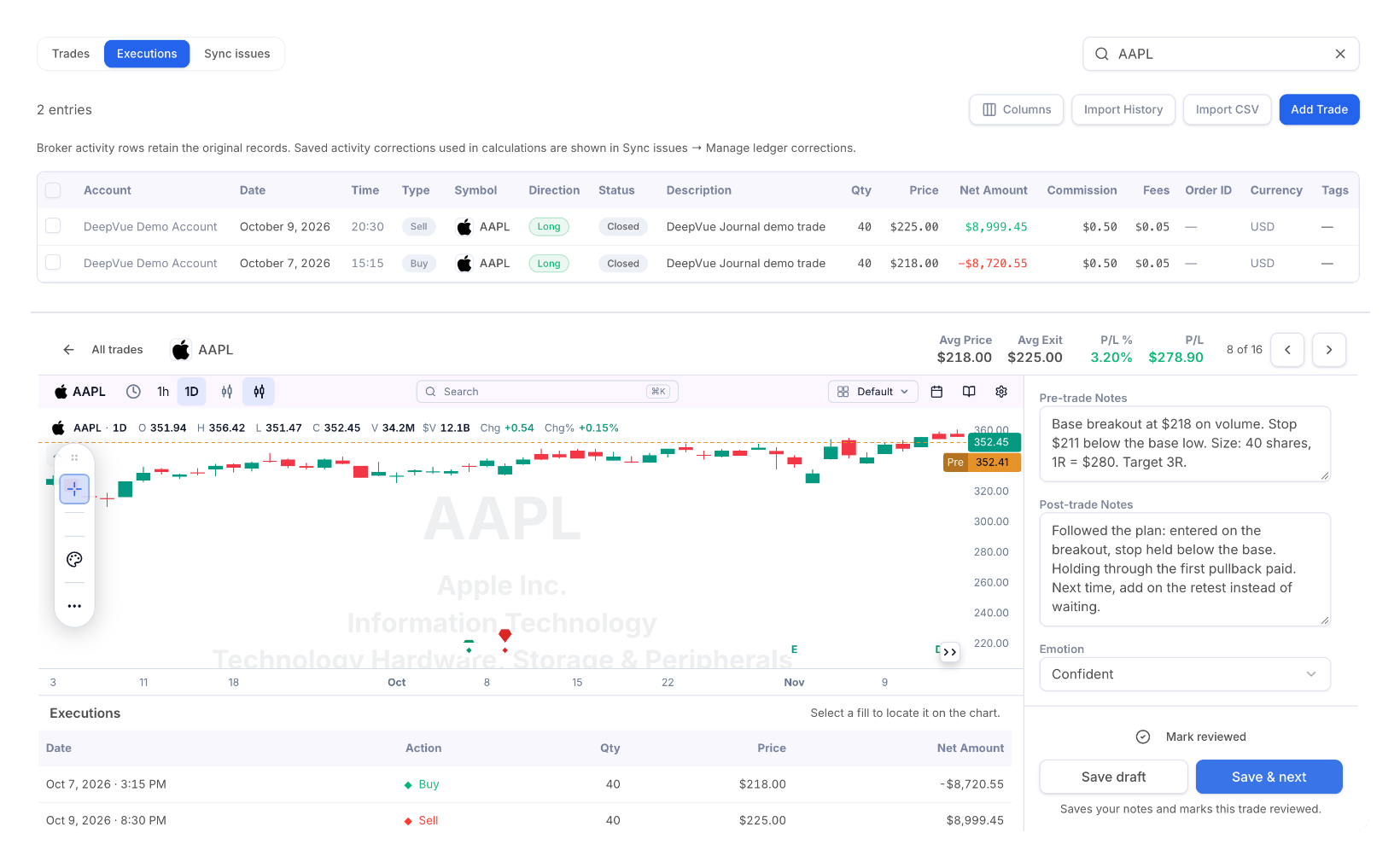
Every useful journal has three layers. The record is the raw fill data: what you bought, when, at what price and in what size. Your broker can supply this part.
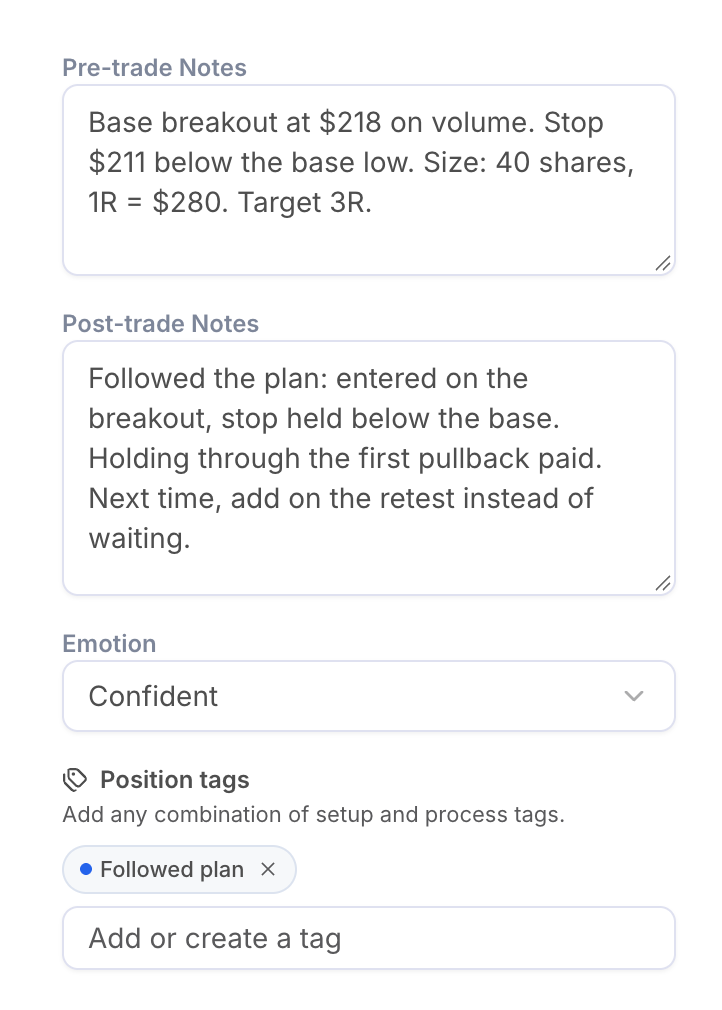
The reason gets written before entry. It’s the plan: the setup you see, where the stop goes and what has to happen for the trade to work. Writing it first means you can’t quietly rewrite it once the result is in.
The review comes after exit. You grade the trade against the plan, tag the emotion you traded with and write one lesson. The record alone gives you a result, and the reason and review show whether your process produced it.
What Is the Purpose of a Trading Journal?
The purpose of a trading journal is to replace memory with evidence. Each review compares what you decided with what the market paid for it, and over enough trades that comparison shows which decisions are worth repeating.
Ask what is journaling in trading at its core and you get a feedback loop. Without a written record, the loop runs on recall, and research on investors shows recall makes a poor witness.
Your Memory Rewrites Your Results
Researchers Daniel Walters and Philip Fernbach asked investors to recall the returns on their most important recent trades, then had them look up the real figures. In their PNAS study, recalled returns ran consistently higher than actual ones, by 4.3 percentage points on the biggest trade.
Two biases did the work. Distortion nudged remembered returns upward, and selective forgetting dropped losing trades out of memory altogether. Investors with the bigger gaps also reported more confidence and traded more often.
In a third study, investors who looked up their past trades showed less overconfidence and lower trading frequency than those who answered from memory. A trading journal is that lookup, kept current after every trade.
Opinions About Your Setups Become Numbers
Once trades carry tags, a hunch like “I trade breakouts better than pullbacks” turns into a figure you can check. The same goes for the state you were in when you clicked buy.
Performance by Emotion in the Deepvue Trading Journal groups closed trades by the emotion you tagged, such as Confident, Neutral or Anxious, and shows results for each. If trades tagged Anxious lose more often, you have a rule to write.
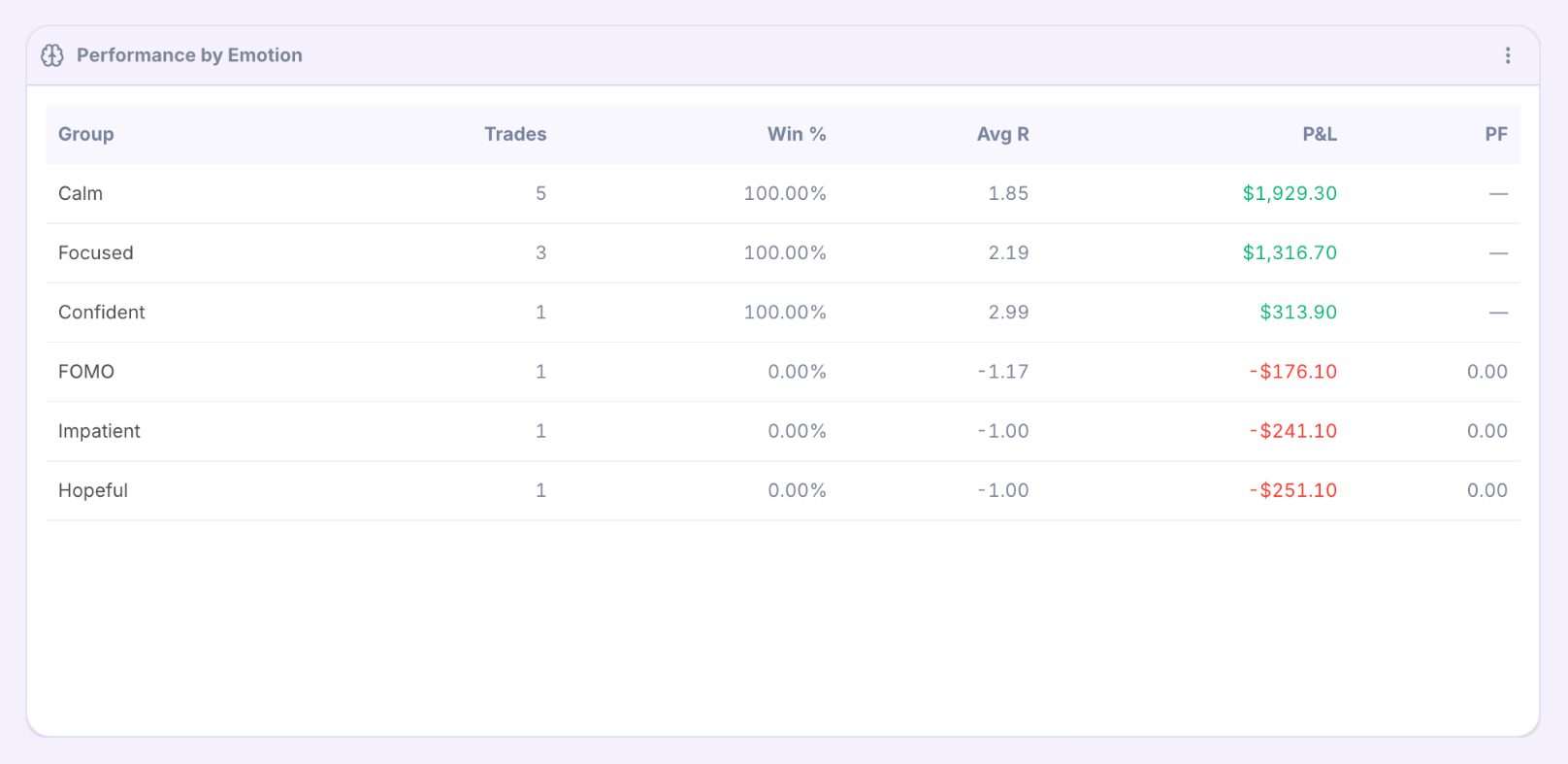
Splitting results by setup, symbol and tag works the same way. Our guide to post trade analysis walks through reading each split and deciding what to change.
Trading Journal Benefits for Traders Who Hold for Weeks
The benefits of a trading journal grow with hold time. A position you carry for six weeks passes through earnings, pullbacks and sector rotation, and each of those moments is a decision worth writing down.
- •Risk you can measure. Logging the stop turns each result into R, the multiple of what you risked, so a $900 gain on $300 of risk reads as 3R. Our risk reward ratio guide covers setting targets around it.
- •Setups that earn their size. Tagging every trade by playbook shows which patterns pay, so you size up the ones with proof behind them.
- •Emotions with a price tag. Tag the state you traded in and the journal puts a dollar figure on trading while anxious or overconfident.
- •Open positions reviewed in time. A weekly look at open trades and their stops catches a position drifting toward its stop while there’s still room to act.
- •Lessons you keep. A note written the week it happened holds up far better than one you try to reconstruct at year end.
That’s the importance of a trading journal in practice: each benefit feeds the next, and the weekly note is where they meet. In Deepvue, the Notebook stores those notes in folders, with templates for a repeatable weekly review and /chart snapshots you can drop in.
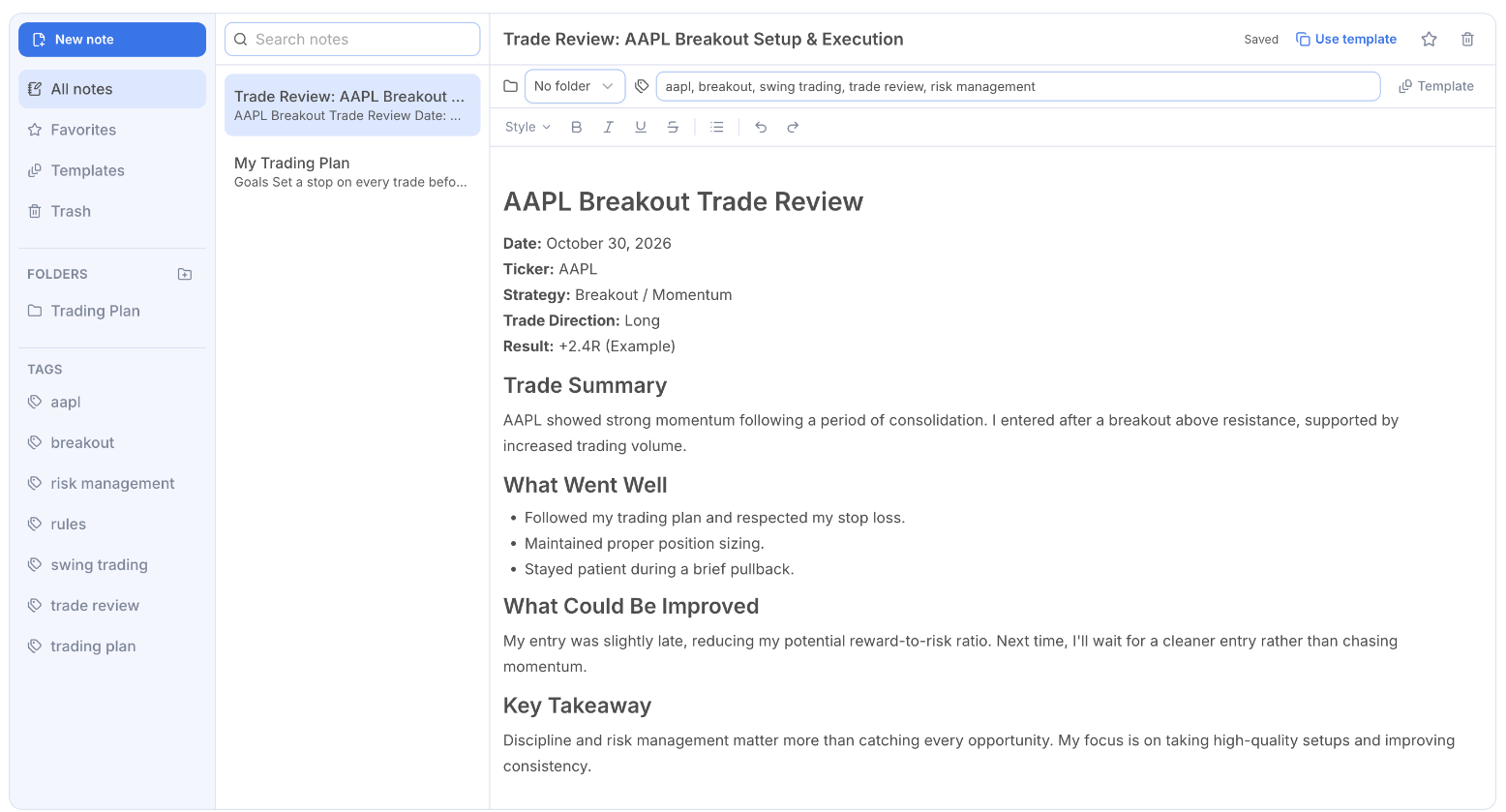
Your best reviewed trades are worth keeping beyond the week they closed. Saved as chart examples, they become a playbook you study before the next setup forms, and Deepvue’s Model Books keep them next to the journal. In the webinar below, Richard Moglen and Ross Haber show how they build one.
Watch how to study A+ setups and build a model book in Deepvue here.
BLACK FRIDAY
Turn Your Trade History Into Evidence for $490 a YearSync your broker, tag each trade and see which setups and emotions pay, on desktop and mobile. Regularly $99 a month or $990 a year.
What a Trading Journal Can’t Do
A journal won’t find trades. It has nothing to say about which stocks are setting up this week, and that work belongs to your screener and charts.
It won’t fix anything on its own either. Logging fills without a review gives you a tidier copy of the broker statement, and the lessons stay locked in the data.
Small samples mislead, too. Five breakout trades with four winners tells you very little, and ten more can flip the picture. Wait for dozens of trades per setup before you change your sizing on the strength of what the journal shows.
Why Traders Stop Journaling, and How Routines Keep the Habit
Logging is rarely where a journal breaks down, especially once the fills sync on their own. The review is what lapses: a busy week turns into a skipped Sunday, and a month later fifty trades are waiting to be graded.
Trading habits take longer to form than most people plan for. A 2024 systematic review in Healthcare found that habits took a median of 59 to 66 days to form, and individual times ranged anywhere between 4 and 335 days.
The same review linked stronger habits to practice at a consistent time and in a stable context. For your journal, that means one fixed slot each week, at the same desk, with the same steps.
Build Your Weekly Journal Review as a Deepvue Routine
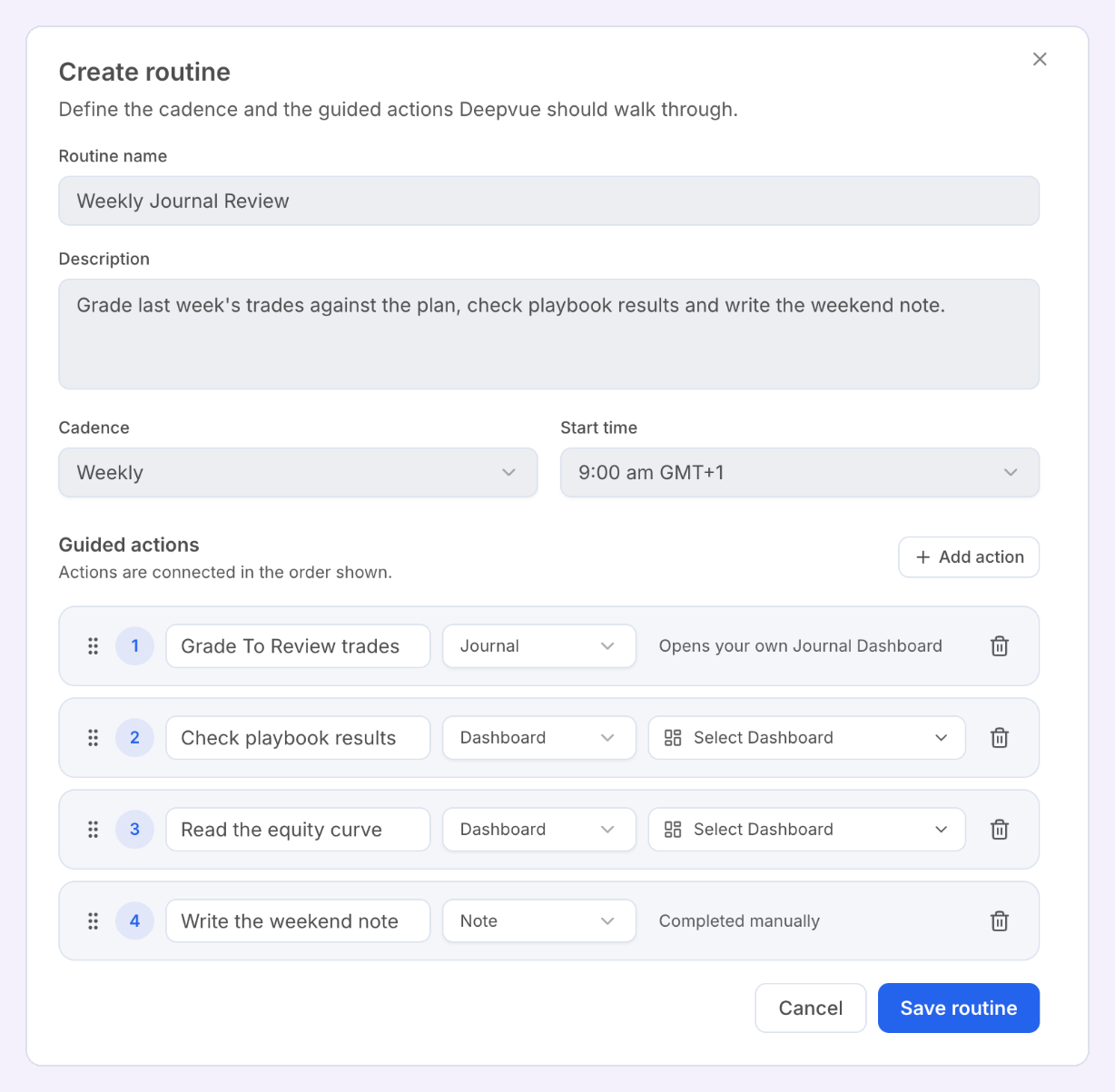
Routines in Deepvue turn a process into a scheduled checklist with guided actions and a streak. Set one up for the journal review:
- •Name it and set the cadence. Call it Weekly Journal Review, pick a weekly cadence and choose a start time, such as Saturday at 9 a.m.
- •Clear the To Review trades. Add an action to work through the To Review filter on the Trades tab and grade each closed trade against its plan.
- •Check results by playbook. Add a step to read Performance by Playbook and note the setup carrying the account and the one dragging on it.
- •Read the equity curve. Look for higher lows and compare the week with the one before it.
- •Write the weekend note. Finish with a Notebook entry from your weekly template, with one lesson and one rule for next week.
Press play when the slot comes up and work through the actions in order. Each completed run extends your streak, which gives you a visible reason to show up next week. For the daily side of the process, see our guide to building a trading routine.
Pair the Review With Your Market Routine
The journal review looks back, and your market routine looks forward. Run them as two separate routines so each one stays short.
The market routine reads conditions on your customizable dashboard: which themes are gaining in the Theme Tracker and which groups lead in Industry Ranks. The journal routine then checks whether your trades lined up with what the market was rewarding.
What a Trading Journal Looks Like in Deepvue
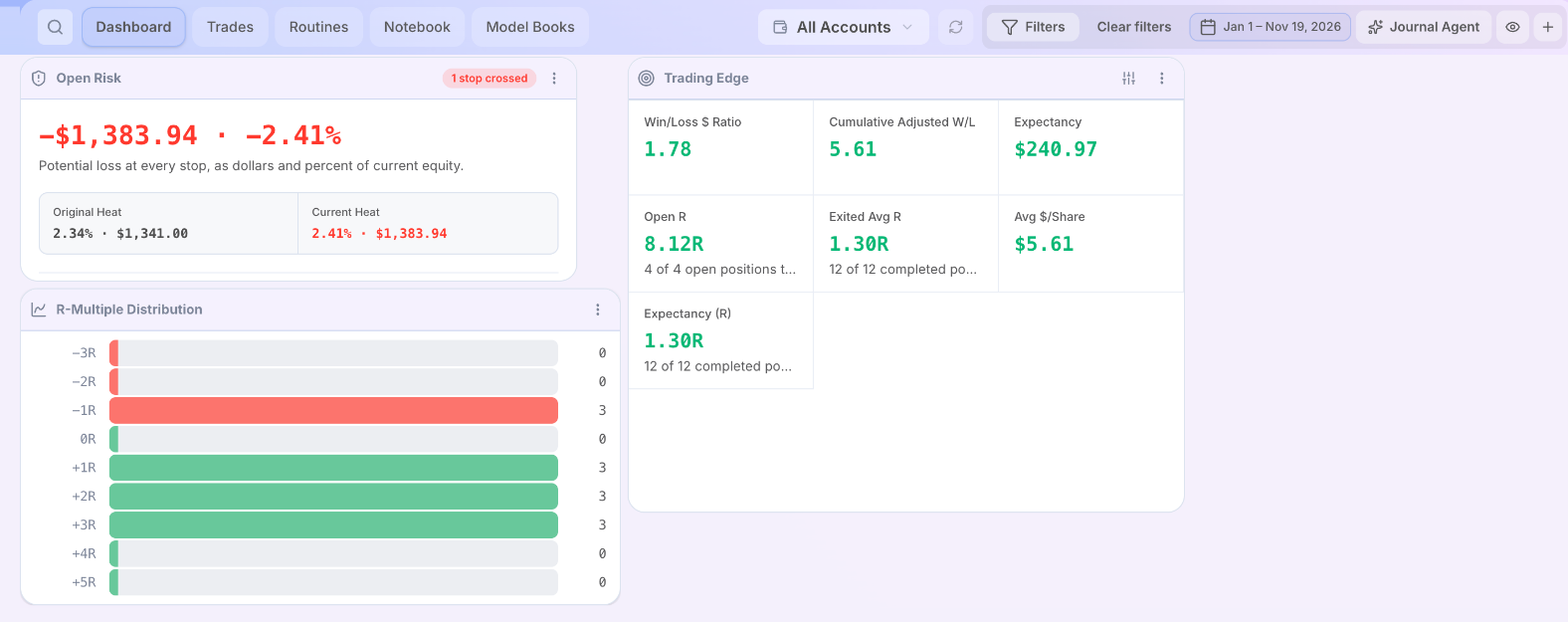
Connect a broker and your fills land in the Executions ledger, grouped into trades. Each trade gets a stop, which gives it an R value and lets Open Risk and Near Stops track it while it’s open.
The trade review holds a chart with your executions, notes before and after the trade, an emotion and a playbook, while the Notebook carries the longer weekly thinking. The Journal Agent reads your trade record, flags weak spots and answers questions about your stats, so the first pass on a month of data is done before you sit down.
It all runs on desktop and mobile from the same account. See the full list of journal features, follow the setup guide to connect your broker, or compare your options in our best trading journal roundup.
BLACK FRIDAY
Run Your Weekly Review in Deepvue for $490 a YearBroker sync, trade reviews, the Notebook, Routines and the Journal Agent, plus the screener and charts you research with. Regularly $99 a month or $990 a year.
Start Your Trading Journal on Desktop and Mobile for $490 a Year
Pick a slot this week, such as Saturday morning, and run your first review. Grade your last ten closed trades against their plans, tag the emotion behind each one and write a single lesson in the Notebook.
Two months from now, that first note is the baseline you’ll measure your progress against.
BLACK FRIDAY DEAL
Deepvue With the Journal Included, Plus 3 Live Bonuses
One annual plan covers the full platform, from screens and charts to the Trading Journal and analytics, plus two VIP Masterclasses and the December Live Bootcamp.
- Deepvue annual planScreener, charts, dashboards, Model Book, Deepvue AI and the Journal with analytics$990/yr
- Momentum Setups Mastery (VIP)3 webinars and a VIP Q&A$297
- Sell Rules Mastery (VIP)3 webinars and a VIP Q&A$297
- December Deepvue Live Bootcamp8 live sessions, December 7 to 14Included
- Total value
$1,584
Your $490 rate stays locked while your subscription is active. Join by December 4, 2026 at 11:59 PM ET.
Reading this on mobile? Claim the deal in your phone’s browser first, then install the Deepvue app and sign in with that account.
Frequently Asked Questions About Trading Journals
How do I create my trading journal?
You create a trading journal by picking a format (a notebook, spreadsheet or app), choosing a few fields and logging every trade. In Deepvue, you connect your broker and fills arrive on their own, so your time goes into the plan and the review instead of data entry.
What goes in a trading journal?
A trading journal holds the date, symbol, size, entry, stop and exit for each trade, plus the setup, the emotion you traded with and one lesson. Deepvue fills in the execution details from your broker, so you only add the stop, playbook, emotion and notes.
What is an example of a trade journal?
An example of a trade journal entry is a single row per trade. Say you buy a base breakout at $84 with a stop at $80.50 and sell at $94.50 three weeks later. That’s 3R, tagged Confident, with a note that holding through the first pullback paid. Deepvue records trades the same way.
What does a trading journal look like?
A trading journal looks like a spreadsheet with one row per trade, or software with a dashboard and a review screen for each trade. In Deepvue, the Dashboard shows performance and risk apps, and each trade opens to a review with a chart of your executions beside your notes.
How many trades before a journal shows real patterns?
A journal usually needs dozens of trades per setup before it shows patterns you can trust, since a handful can swing either way on luck. Deepvue’s date filters and playbook tags let you check each setup’s sample size before you act on what it shows.
What is the difference between a trading journal and a trading plan?
The difference between a trading journal and a trading plan is timing. The plan sets your rules before you trade, and the journal checks afterward whether you followed them. Deepvue’s trade review puts your plan note and the result side by side.
Can AI keep a trading journal for you?
AI can keep part of a trading journal for you. It can read your trade record, total your stats and point out weak setups, but it can’t supply the plan you had or the emotion you traded with. Deepvue’s Journal Agent handles the analysis while you write those parts.
Can I try the Deepvue Trading Journal before connecting a broker?
Yes, you can try the Deepvue Trading Journal before connecting a broker. Demo trades fill every app until you erase them, so you can test reviews, tags and Routines first. Deepvue is $99 a month or $990 a year, and Black Friday brings a full year to $490 through December 4.
Why is a trading journal important?
A trading journal is important because a broker statement only shows results, not decisions. The journal records the plan, the stop, the setup and the emotion behind each trade, so you can see which choices made money. Deepvue pairs every imported fill with those notes, so the review shows the decision behind the number.
What are the benefits of a trading journal?
The benefits of a trading journal are clearer patterns, tighter risk and fewer repeated mistakes. Logging the setup, R multiple and emotion on each trade shows which setups pay and which habits cost you. In Deepvue, the Dashboard turns those fields into performance and risk apps, so the patterns show up without building a spreadsheet.
What is journaling in trading?
Journaling in trading is the habit of recording every trade with the reasoning around it: the plan before entry, the execution, and a short review after the exit. It turns trading into a feedback loop instead of a string of guesses. Deepvue imports the execution side from your broker, leaving you the plan and the review.
How often should I review my trading journal?
You should review your trading journal daily for a few minutes and weekly in more depth. The daily pass logs notes while the trade is fresh; the weekly pass looks across trades for patterns by setup and emotion. Deepvue keeps each trade review beside its chart, so the weekly session starts with the data already in place.
How long does it take to build a journaling habit?
Building a trading journal habit takes roughly 60 days for most people, based on habit research showing new routines take about two months to become automatic. Keep each entry short at first so the habit survives busy days. Deepvue cuts the work by importing fills automatically, so each entry needs only the stop, setup, emotion and lesson.
Is a spreadsheet good enough for a trading journal?
A spreadsheet is good enough for a trading journal when you trade a few times a month and enter every fill by hand. It gets harder as trade count grows, because partial fills, R math and charts take manual work. Deepvue imports fills from your broker and calculates R and performance stats for each trade automatically.
Do swing traders need a trading journal?
Swing traders need a trading journal as much as day traders, because holds of days or weeks hide mistakes in sizing, stop placement and selling too early. A journal shows whether exits or entries cost more. In Deepvue, each swing trade’s review shows the executions on the chart, so you can see where you sold against the move.
Can I keep my trading journal on my phone?
You can keep a trading journal on your phone with an app that syncs to your desktop account, which helps you log notes right after a trade. Deepvue’s mobile app signs in to the same account as the desktop platform, so trades imported from your broker and notes added on either device appear in one journal.
Sources
- •Walters and Fernbach, Investor memory of past performance is positively biased and predicts overconfidence, Proceedings of the National Academy of Sciences, 2021
- •Singh, Murphy, Maher and Smith, Time to Form a Habit, a systematic review and meta analysis in Healthcare, 2024