The Pocket Pivot Screener That Finds Buying Inside the Base
A pocket pivot is an up day whose volume beats the largest down day volume of the prior ten sessions, while the stock is still inside a base. It marks institutional buying before the breakout, for an earlier and cheaper entry. Deepvue’s pocket pivot screener ships as a preset with the volume signature and context conditions built in. $99 a month.
Key Takeaways
Everybody can see a breakout, and that’s the problem. By the time a stock clears the obvious level, everyone running the same playbook is buying the same price, and crowded entries get shaken out.
The buying behind a breakout starts weeks earlier, inside the base, and institutions can’t hide the volume. Deepvue’s screener tests that volume signature and its context in one pass, so you look for the pattern on purpose instead of stumbling on it.

- ✓The rule is exact: an up day whose volume tops the biggest down day volume of the prior ten sessions
- ✓The context rules take judgment, so the screen narrows the field and the chart picks the trade
- ✓The signal must fire inside a base, never after the stock is extended
- ✓The pivot day’s low, or the nearby moving average, sets your stop before you enter
- ✓Later pocket pivots off the 10 day line are for adding to a winning position
- ✓The preset, the fields and the alerts all come on one $99 a month plan
What Is a Pocket Pivot?
Dr. Chris Kacher developed the pocket pivot in 2005, when a choppy market kept breaking conventional base breakouts and stopping out traders who did everything right. The question was whether you could buy the same stocks earlier, below where the normal shakeout reaches.
The answer, worked out with Gil Morales and published in Trade Like an O’Neil Disciple, was to watch volume instead of price. Accumulation inside a consolidation produces a volume day taller than any recent selling. That’s the pocket pivot: a valid entry hiding in the pocket of the base, below the obvious one on top.
The Pocket Pivot Volume Rule Is the Only Exact Part
The full pattern has no universally agreed definition, but the volume test is precise and has never changed.
| Step | What you check |
|---|---|
| 1. Look back ten sessions | Take the prior ten trading days and keep only the down days |
| 2. Find the heaviest one | The highest volume among those down days is your threshold |
| 3. Check today | Today must be an up day with volume above that threshold |
| 4. Check the position | The stock must still be inside a base or constructive uptrend, not extended |
The question isn’t whether volume was high. It’s whether today’s buying outweighed the heaviest selling of the past two weeks, which makes the reading about supply and demand rather than activity.
Why It Works as an Early Entry
A breakout says demand has overwhelmed supply at a level everyone can see. A pocket pivot says the same thing quietly, at a price nobody is watching. Entering inside the base puts your stop closer, so the same dollar risk buys a bigger position and normal breakout volatility is less likely to shake you out. It’s a risk argument, and it predicts nothing.
The Conditions the Volume Rule Doesn’t Cover
This is where most traders get the pocket pivot pattern wrong. The volume test is necessary and nowhere near sufficient:
- •The right place. Inside a base or constructive uptrend, ideally in the lower half to middle of the range, never extended above it.
- •Off a moving average. The stock moves up and off, or up and through, the 10 day or 50 day line, which gives the entry a reference point.
- •A strong close. A close in the upper half of the day’s range shows buyers held control. A lower half close says the volume wasn’t all demand.
- •Calm action beforehand. Orderly pullbacks on quiet volume, with price tightening near support, make the signal far more reliable.
- •A business worth owning. Kacher and Morales applied the pattern to leading growth companies, not anything that cleared the volume test.
The Bottom Fishing Pocket Pivot Debate
The original work describes a bottom fishing pocket pivot, where the signal appears as a beaten down stock rounds out a low. Plenty of practitioners in the same tradition argue pocket pivots should never be used to bottom fish. Both camps work from the same book. Pick one, because it changes your screen.
Why Pocket Pivots Are Awkward to Screen For
The volume rule sounds like something any screener handles. Most can’t, because it’s a conditional comparison across a rolling window: look back ten days, sort them by direction, take the maximum of one subset and compare today against it. Simple field comparisons can’t express that.
So pocket pivot trading usually starts with squinting at volume bars chart by chart, the pocket pivot pattern gets a reputation for being subjective, and a pocket pivot scanner that actually runs the comparison stays rarer than it should be.
Why Deepvue Is the Best Pocket Pivot Screener
Deepvue ships the comparison as a preset, then gives you the fields to check what the volume test can’t. A pocket pivots stock screener needs both to be worth opening.
A Pocket Pivot Scanner That’s Already Built
Pocket Pivots loads in one click from the Technical presets. It’s no two condition approximation: the volume signature and the structural context are tested together.
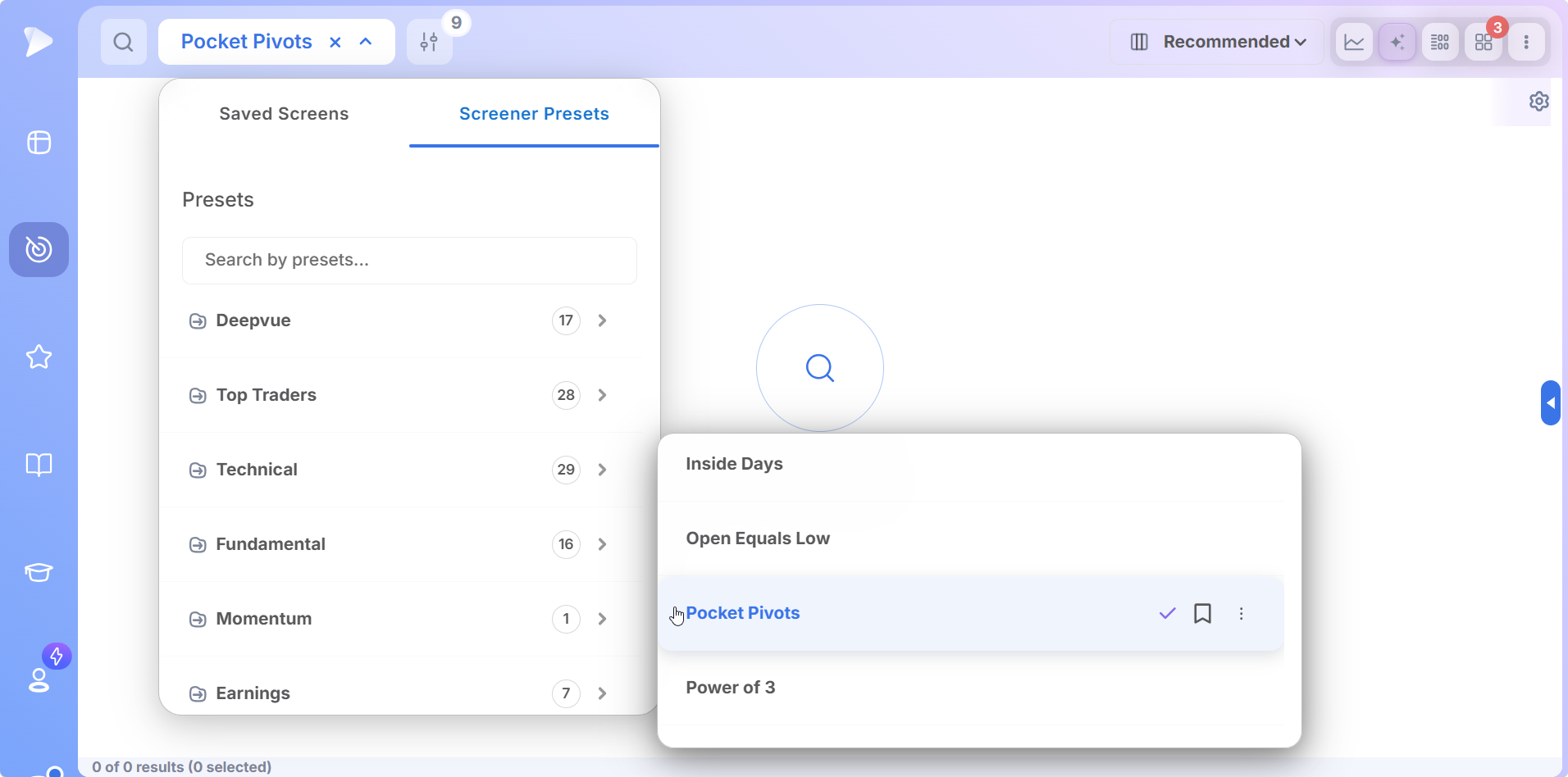
Presets are locked. Save a copy and every threshold is yours to set.
Up/Down Volume Shows What Happened Before Today
The up/down volume ratio pairs best with this pattern, showing whether recent turnover has favored advances or declines.
A pocket pivot in a stock with a climbing ratio is the visible spike in accumulation already underway. The same signal after heavy volume on down days is more likely a single burst inside distribution. The pivot is one day, and the ratio is its context.
Closing Range as a Pocket Pivot Indicator
No single pocket pivot indicator settles the pattern, but daily closing range gets close. The upper half close is usually checked by eye. Closing range turns it into a number, so a minimum goes straight into the screen and weak closes never reach your list. The weekly version checks whether the pivot’s week also finished near its high.
The Chart Still Decides
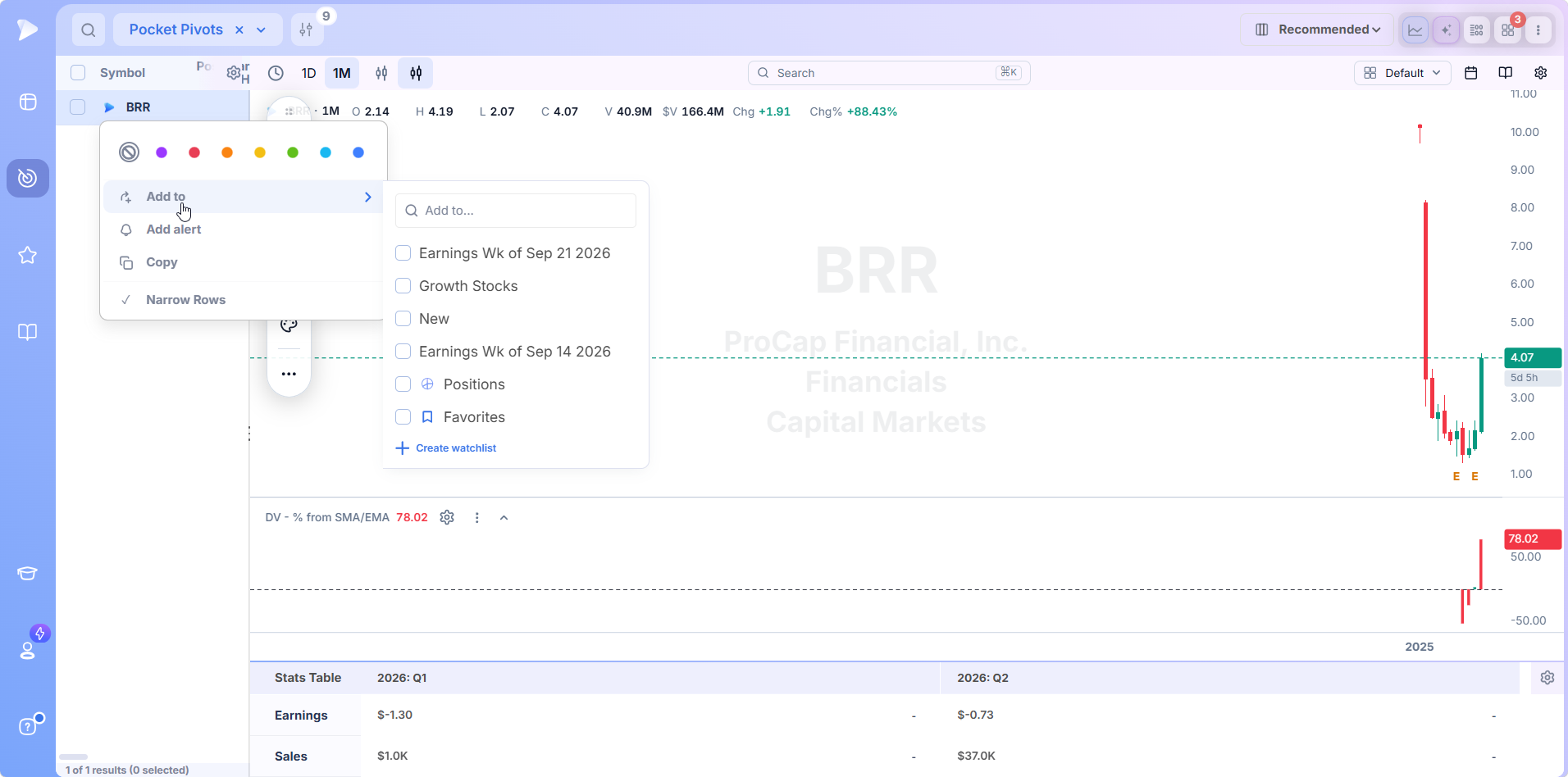
Base position resists automation, because judging the lower middle of a constructive range takes an eye. The screen cuts 600 charts to 20, and every row opens next to its chart, so each check is quick. Look for:
- •Price inside the range, not above it
- •Calm action leading into today
- •A close near the high of the day
- •A moving average underneath as the entry’s reference
The Table You Read It In
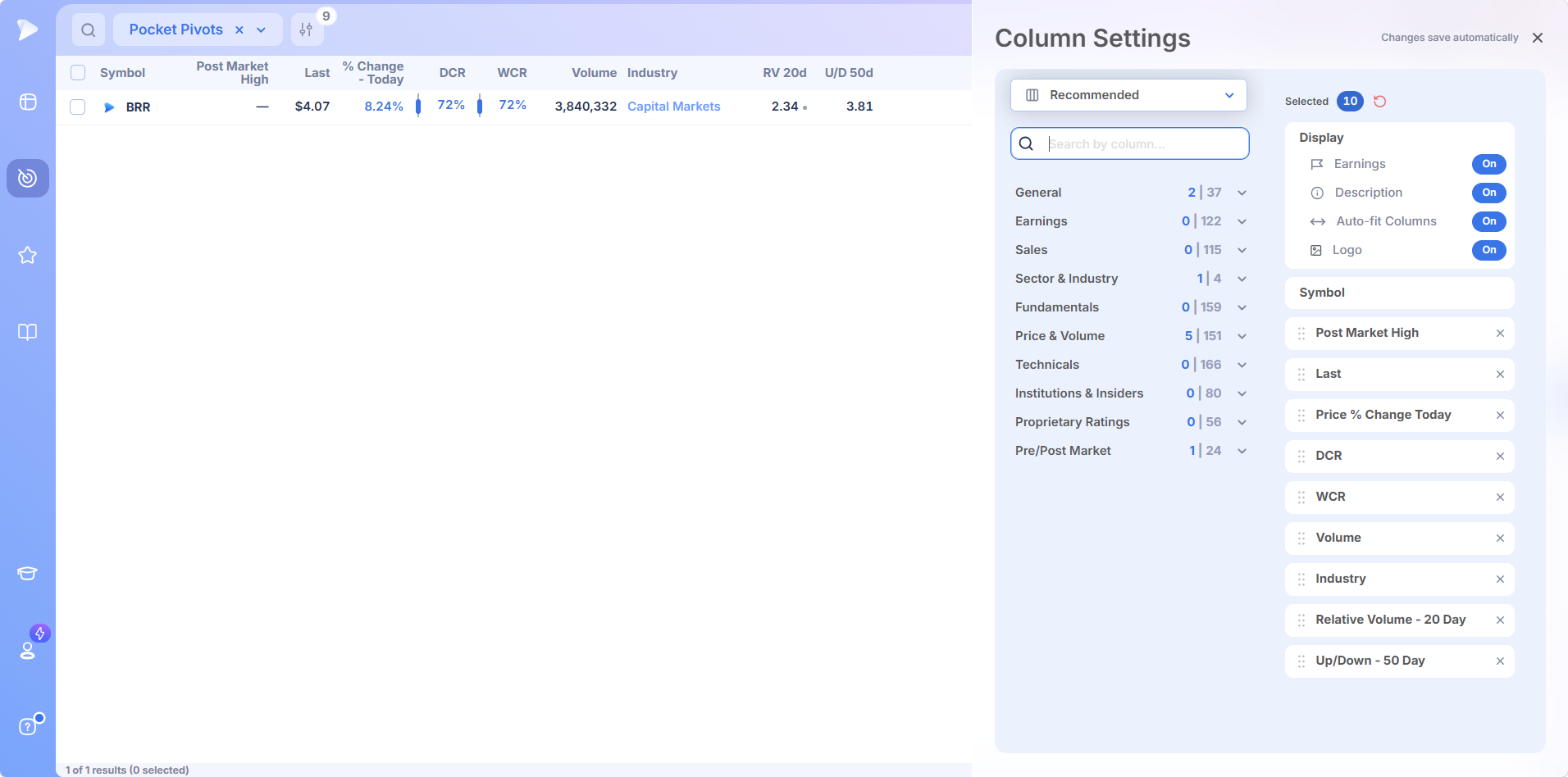
For this pattern, the columns that matter are relative volume, up/down volume, closing range and distance from the moving averages. Add them once, save the layout, and your pocket pivot stock screener opens ready for this job.
How to Build Your Own Pocket Pivot Stock Screener
Start from the preset and tighten it to your tolerance. Six steps, then it stays saved.
Open the Pocket Pivots preset and duplicate it to unlock every condition.
Keep the volume signature intact. That comparison is the pattern.
Add a closing range minimum around 50% to enforce the strong close.
Add moving average proximity so the signal comes off the 10 or 50 day line.
Require some distance from the highs to keep results inside bases.
Finish with quality and tradeability: relative strength, earnings and sales growth, a price minimum and a turnover floor.
Quicker to write it out? The AI Terminal converts a description into the condition set for tuning.
How to Trade a Pocket Pivot
Finding one is the easy half. Most of the damage in pocket pivot trading happens after the screen returns the name.
The Pocket Pivot Buy Point and the Timing Problem
The trigger is price crossing the prior day’s close while volume is on track to qualify, but volume is only final at the bell. The usual fix is to act in the last hour, once volume can be projected with confidence.
A common convention sets the entry range around the pocket pivot buy point from the session low to about 5% above the trigger. Beyond that you’re chasing.
Where the Stop Goes
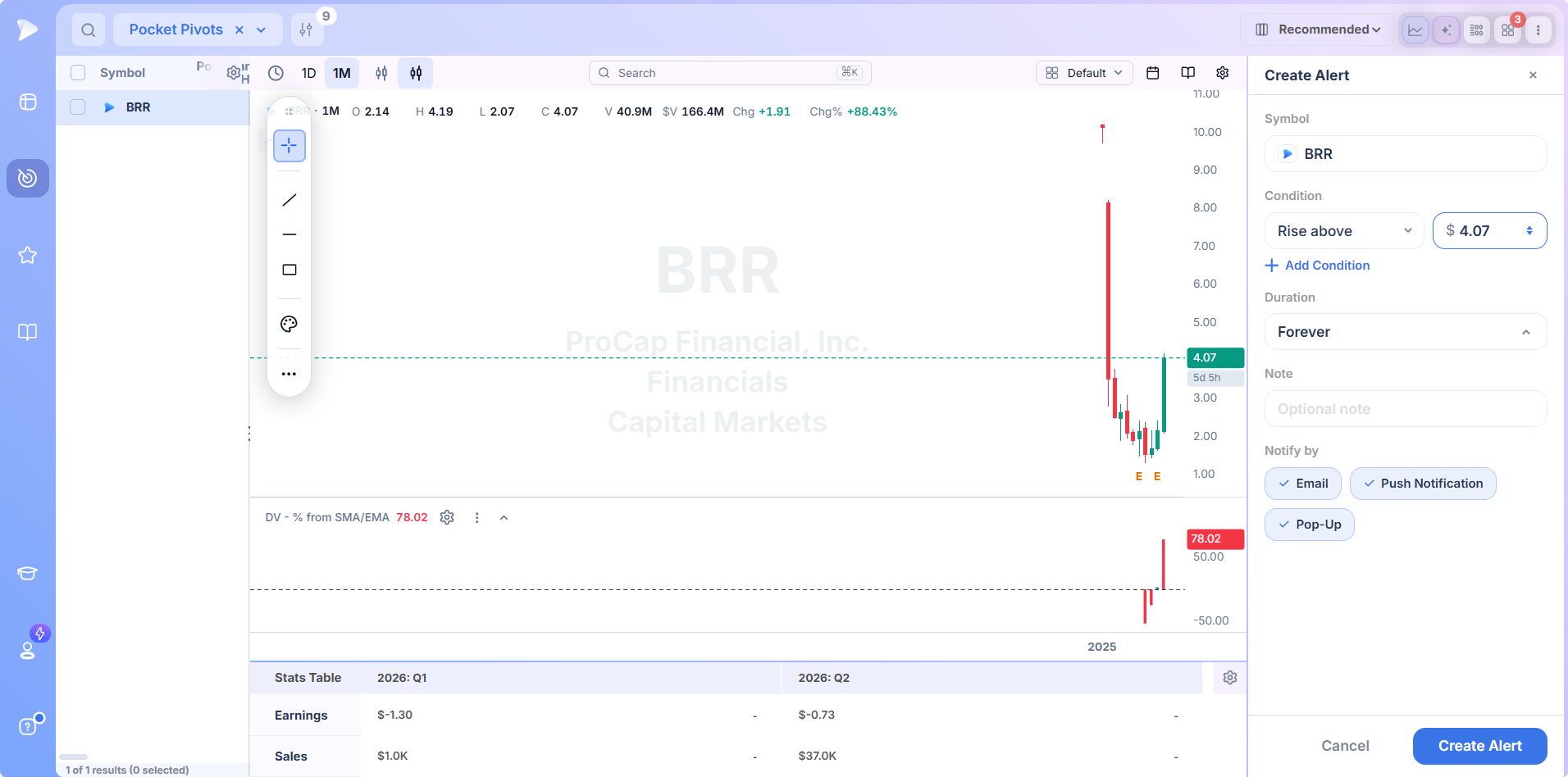
Below the pivot day’s low or the nearby moving average, whichever is closer. That’s unusually clean for a chart pattern, and the position size calculator converts that distance into how many shares to buy. If the stock closes back under the low, the accumulation thesis is done.
Adding, Not Just Entering
A stock in a healthy advance produces more pocket pivots, usually off the 10 day line, and each is a chance to add to a winner. Run the screen against a watchlist of your holdings and it becomes an add signal generator: a first tranche at the pivot inside the base, a second at the breakout, a third at a continuation pivot. That’s a campaign, and it’s how the pocket pivot strategy was designed to work.
Pocket Pivot, Breakout or Contraction?
All three describe moments in the same story:
- •Contraction first. Range tightens through the base as supply dries up.
- •Pocket pivot next. Demand leaves a volume footprint taller than any recent selling, still without a new high.
- •Breakout last. Price clears the range on heavy volume and the move becomes obvious.
Tightness is measured on the volatility contraction pattern screener, the footprint is what the pocket pivot screener finds, and everyone already knows how to find breakouts. Run the first two together to arrive early.
When a Pocket Pivot Should Be Ignored
A pocket pivot strategy is only as good as the signals you decline.
- •Already extended. A pivot well above the base puts your stop far beneath your entry.
- •After wedging low volume up days. Price creeping higher on drying volume usually means the buying arrived late.
- •Under a falling 50 day line. A volume spike beneath a declining average is more often a bounce in a downtrend.
- •A weak close. Heavy volume finishing in the lower half of the range means sellers met the buying.
The signal says institutions appear to be accumulating. Whether the stock deserves your money and the market will cooperate is still your call.
Who Gets the Most From This Screen
- ✓Traders tired of getting shaken out of breakouts
- ✓Anyone building positions in stages instead of full size at one price
- ✓Growth traders tracking which bases are under accumulation
- ✓Holders of leaders who want continuation pivots flagged as add points
- ✓Anyone who wants the stop defined before the position is opened
Pricing
Join by November 12 and your $490/year rate stays locked for as long as your subscription is active. $99 a month on a single plan, nothing gated.
- •Every preset, this one included, fully editable once you duplicate it
- •The complete field library, so volume ratios, closing range and moving average distances filter together
- •Charts, lists, alerts and saved layouts, the route from signal to stop
- •Live data through the session, which matters because the entry decision comes in the last hour
The comparable platform, MarketSurge, is $149 a month.
New accounts include a setup call, introductory emails and weekly webinars that each take one module apart.
Buy Where Nobody Is Looking
The best price in a stock is rarely the obvious one. Institutions buy in consolidations for that reason, and their volume is the one part they can’t hide. A pocket pivot screener reads it.
Every chart formation Deepvue scans for is gathered under stock screener by pattern. Scans triggered by a signal are listed in screener by indicator, while screener by strategy focuses on strategies.
Run the pocket pivot screen tonight
↑ Back to contentsFrequently Asked Questions
What is a pocket pivot?
A pocket pivot is an up day inside a base whose volume beats the highest down day volume of the previous ten sessions. It marks institutional buying before the breakout, which gives you an earlier entry. Deepvue screens for it with a built in preset.
How is a pocket pivot defined in trading?
In trading, a pocket pivot is defined by one exact volume comparison plus several judgment calls. The volume rule never changes. Base position, moving average proximity and a close in the upper half of the range need interpretation, and Deepvue’s fields help check them.
Who invented the pocket pivot?
Dr. Chris Kacher invented the pocket pivot around 2005, when choppy markets kept breaking conventional base breakouts. He and Gil Morales published it in Trade Like an O’Neil Disciple, and Deepvue’s Pocket Pivots preset follows that original definition.
Is a pocket pivot a buy signal?
A pocket pivot is a signal to look closely rather than an automatic buy. It says institutions appear to be accumulating. Base quality, the business and the market are separate questions, and Deepvue lets you add those conditions to the same screen.
What is the pocket pivot volume rule?
The pocket pivot volume rule takes the last ten sessions, isolates the down days, finds the highest volume among them, and requires today to be an up day beating that figure. Deepvue’s Pocket Pivots preset runs the comparison for you.
How do you find pocket pivots?
You find pocket pivots either by flipping through volume bars, which is slow and inconsistent, or with a pocket pivots stock screener that runs the comparison directly. Deepvue’s preset does, with closing range, moving average and quality conditions layered on top.
Is there a pocket pivot indicator?
There’s no single pocket pivot indicator, because the pattern is a volume comparison plus context. Deepvue gets closest by pairing the Pocket Pivots preset with daily closing range and up/down volume, which confirm the strong close and the accumulation behind it.
Where do you put the stop on a pocket pivot?
The stop on a pocket pivot goes below the pivot day’s low or the nearby moving average, whichever is closer. Having risk defined on entry day is much of the appeal. Set a Deepvue alert at that level and the trade watches itself.
Pocket pivot versus breakout: what changes?
Between a pocket pivot and a breakout, what changes is timing and visibility. A breakout happens at a new high in public view. A pocket pivot happens inside the base and shows only in volume, so the entry is earlier and the stop tighter. Deepvue screens both separately.
Can you use pocket pivots to add to a position?
Yes, you can use pocket pivots to add to a position, and it’s the underused half of the pattern. Leaders produce continuation pivots off the 10 day line as they advance. Run the Deepvue screen against a watchlist of your holdings to flag each add point.