The Buyable Gap Up Screener That Separates Real Gaps From Noise
A buyable gap up screener finds stocks that opened well above the prior close on heavy volume, inside an uptrend, and held the gains into the close, the condition most tools miss. Deepvue screens gap size, relative volume, trend and closing range in one query, so you see the gaps institutions bought. One plan, $99 a month.
Key Takeaways
Every morning brings a page of gap stocks. Most gapped on thin news, faded from the first print and closed near the low, leaving whoever bought the open underwater by lunch.
A few are genuine repricings, where an institution decided overnight the stock was worth far more and spent the session proving it. Deepvue’s screener separates the two with four measurements in one query, on live data.
- ✓A buyable gap up needs a real gap, volume well above average, an uptrend and a close that holds the gains
- ✓Daily closing range separates accumulation from distribution, and most screeners skip it
- ✓Volume must be relative to each stock, since fixed share counts mean nothing market wide
- ✓The gap day’s intraday low is your risk point, which makes sizing simple
- ✓Scale gap size to the stock’s own range instead of a flat percentage
- ✓$99 a month for everything, against $149 for MarketSurge
What Is a Buyable Gap Up?
Gil Morales and Chris Kacher coined the buyable gap up while working through the O’Neil methodology. A stock gapping up on enormous volume is being repriced, and the buyers doing it rarely finish in one session. It’s buyable when these conditions line up:
| Condition | Why it matters |
|---|---|
| Quality underneath | A sound leader, or a stock in a theme with a compelling reason behind it |
| A substantial gap | At least 0.75 times the 40 day average true range, scaled to each stock |
| Volume confirmation | At least 1.5 times average daily volume |
| The right context | An uptrend or constructive consolidation, not partway down from a high |
| It holds the low | Price stays above the gap day’s intraday low |
Why the Intraday Low Is the Whole Setup
The gap day leaves a clean level: the lowest price anyone paid the day the story changed. Lose it and the thesis is wrong. Most entries make you guess where you’re wrong, but a buyable gap up hands you the number to plug straight into the position size calculator.
The Bottom Fishing Variant
There’s one exception to the uptrend rule. A stock beaten down for months builds a low base, then gaps hard on real news and marks the turn. Morales and Kacher call it a bottom fishing buyable gap up, with bigger potential, lower reliability and a demand for truly extraordinary volume.
Why Most Lists of Gapping Stocks Hand You Junk
Search for gap stocks on any morning and you’ll find plenty of lists. The trouble is what a typical stock gap scanner ranks by:
- •Gap percentage alone. A $2 biotech tops the list daily while the mid cap that gapped 7% on a transformative quarter gets buried.
- •A flat threshold. A 4% gap is ordinary for a volatile name and extraordinary for a steady one.
- •Volume in shares. Two million shares means nothing without knowing what’s normal for that stock.
- •No view of the close. The big one. A gap that opens high and closes near the low is institutions selling into strength.
Fix those four and hundreds of gapping stocks shrink to a handful.
Why Deepvue Is the Best Gap Up Screener for This Setup
Each of those problems has a field that solves it.
The BGU Preset Does the First Pass
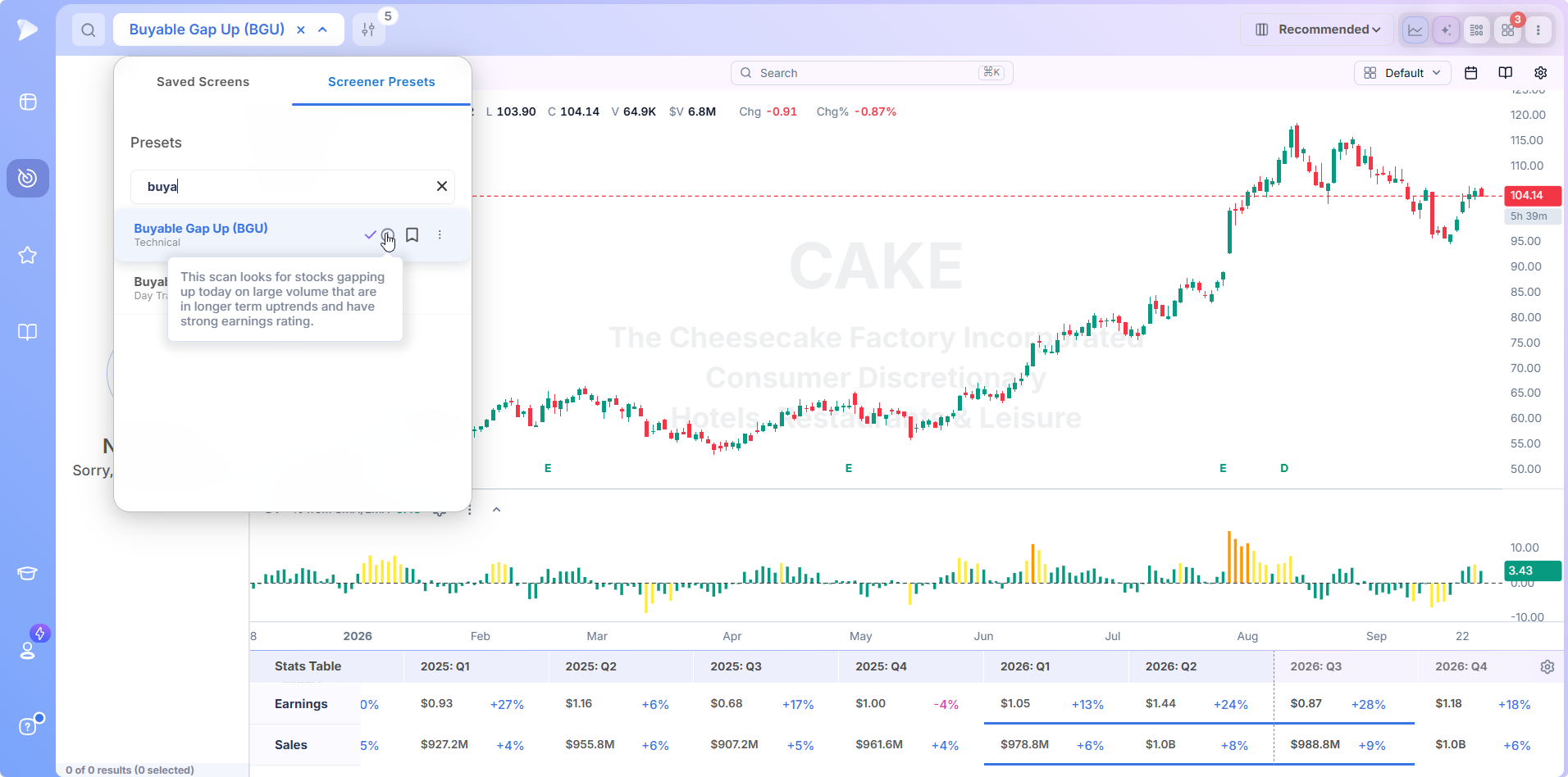
Deepvue’s Buyable Gap Up (BGU) scan, in the Technical presets, loads in one click and finds stocks gapping up today on large volume, in longer term uptrends, with a strong earnings rating.
That mirrors the classic definition, with the earnings rating standing in for quality, the part most gap up scanners skip. Run it as it ships, or save a copy and tune every threshold into your own gap up strategy.
The One Condition Worth Adding Yourself
If you change one thing, add daily closing range: where the stock finished inside its daily range, as a percentage. The nineties mean a close near the high, single digits a close near the low.
On a gap day that says more than the gap. A 6% gap closing at 95% of its range had buyers in control all session. The same gap closing at 8% gave everything back to a bigger seller. Both show up on an ordinary gap up scanner or stock gap scanner, and only one belongs on your list.
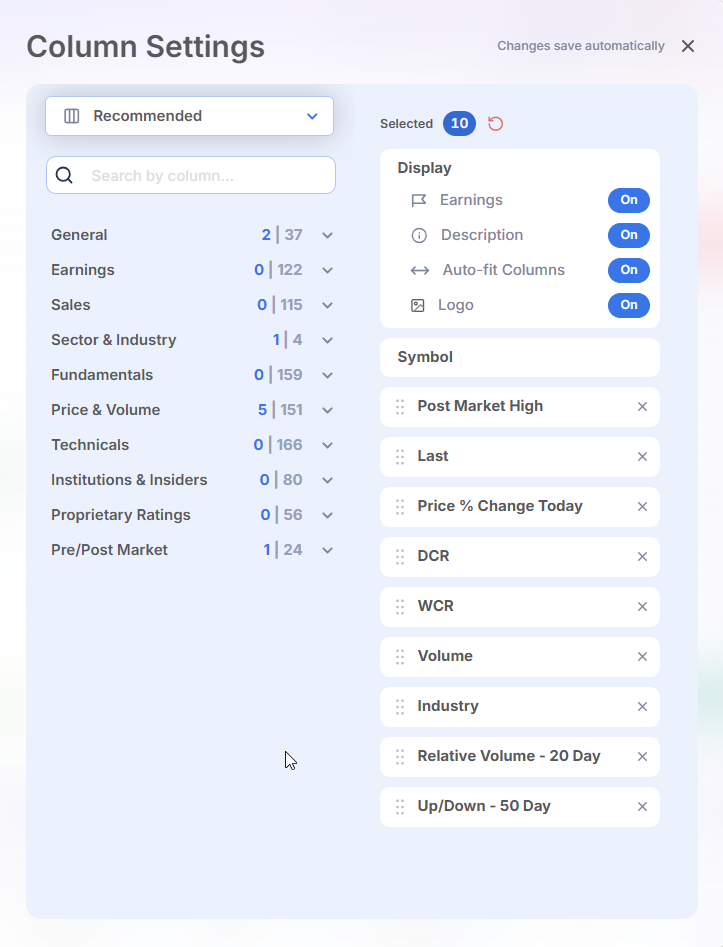
Weekly closing range asks the same question over the week, useful when you want to know if an earlier gap has been defended.
Volume Measured Against the Stock, Not the Market
Relative volume compares today’s turnover with the stock’s own average, so the 1.5 times threshold works market wide as one condition. The up/down volume ratio adds whether volume has been arriving on up days or down days, which shows on a stock quietly accumulated before it gaps.
Trend Structure in the Same Query
The uptrend requirement is where a gap up stock screener earns its place. Distance from the 50 day and 200 day averages, how they relate, relative strength ranking and distance from the 52 week high are all filterable, so nothing waits for a chart check. A big gap on real volume, closing strong, in a stock already leading: one query.
The Catalyst, Attached
Most gap stocks worth trading gapped on earnings, and the earnings fields share the table: sales surprise on the latest quarter, growth history, estimate revisions and the next report date. Turn on the earnings flag and every company that just reported gets a marker in its row.
How to Build a Gap Up Stock Screener From Scratch
Five conditions, biggest filters first.
Set the gap condition: percent change from the prior close, or better, scaled to average true range.
Require relative volume above 1.5.
Add a daily closing range minimum around 70, so only gaps that held survive.
Add trend structure: price over both the 50 day and 200 day averages, with strong relative strength.
Add price and dollar volume floors, then save the screen and run it every afternoon.
Faster to describe it? The AI Terminal builds the screen from a plain sentence, ready for you to adjust.
Buyable Gap Up or Episodic Pivot?
The terms get used interchangeably, and one screen usually catches both, but they describe different things. An episodic pivot is the event: news big enough to change the market’s view of a company in one session, ideally in a stock that was ignored. A buyable gap up is the entry: the price structure that event produces and the conditions that make it actionable.
The strongest gaps are both. The screening difference is that an episodic pivot can hit a stock with no prior uptrend, while a classic buyable gap up wants a leader. Keep the trend condition in your main screen and run a looser version alongside it to catch the turns.
When a Gap Up Is Not Buyable
A gap trading strategy that ignores these failure modes loses money predictably.
- •The gap is already the move. A stock far extended from its base has priced the news and then some.
- •The volume isn’t there. A gap on ordinary turnover is a quote rather than a repricing, and it fills far more often than it runs.
- •It closed badly. Opening at the high and closing at the low is distribution in a bullish costume, exactly what closing range catches.
- •The market is against it. In a correction the setup fails repeatedly, a reason to cut size rather than drop the pattern.
Gaps fail. The screen compresses a morning of chart flipping into minutes and hands you a defined level to be wrong at.
Who Should Be Running This Screen
- •Traders buying institutional repricing events and holding them for weeks
- •Growth traders working earnings season, when most of these setups appear
- •Anyone sizing positions off a defined level
- •Traders scanning gainers lists by hand for stocks gapping up today
- •Anyone who wants catalyst, price structure and trend in one place
Pricing
Join by November 12 and your $490/year rate stays locked for as long as your subscription is active. One subscription, $99 a month, everything included.
- •Every preset and the whole field library, including closing range, relative volume and up/down volume
- •Live data while the market runs, so a gap fading at 2pm is visible at 2pm
- •Charts, watchlists, alerts and saved layouts, the full path from list to risk point
- •Earnings and estimate fields, so the catalyst behind a gap is one column away
MarketSurge asks $149 a month for its equivalent.
New accounts get a one on one setup session, emails introducing each module and a weekly live webinar that takes one area apart.
Catch the Repricing, Not the Noise
The gap is the easiest thing to see and the least useful to know. The volume behind it, the trend beneath it and the close after it decide whether it’s worth owning, and a gap up stocks screener checks all three faster than you can.
More chart formations are gathered in stock screener by pattern. Signal based setups are grouped in screener by indicator, and screener by strategy sorts them by strategy.
↑ Back to contentsFrequently Asked Questions
What is a buyable gap up?
A buyable gap up is a stock that opens well above the previous close on heavy volume, inside an uptrend, and holds those gains through the session, with the intraday low as the risk point. Deepvue screens all four conditions, including the closing range that confirms the hold.
What are gap up stocks?
Gap up stocks open meaningfully above the previous close, usually on earnings, deals, upgrades or overnight news. Most stocks gapping up today fade. The keepers pair the gap with heavy relative volume and a strong close, exactly what a gap up stocks screener in Deepvue filters for.
How do you screen for gap up stocks?
You screen for gap up stocks by setting a gap size condition, requiring relative volume above about 1.5, demanding a high daily closing range and adding trend structure. Deepvue’s Buyable Gap Up (BGU) preset already covers the gap, volume and trend conditions.
Why do stocks gap up?
Stocks gap up because news arrives while the market is closed and the opening auction reprices them in one move. Earnings cause most gaps, with deals, regulatory decisions and analyst actions making up the rest. Deepvue shows the earnings fields right beside price data.
Is a gap up bullish?
A gap up is bullish only when it holds. A gap that keeps its gains on heavy volume in an uptrending stock is bullish, while one that fades to close near the low is distribution. Both look identical at the open, and Deepvue’s closing range filter separates them.
Do gaps always get filled?
Gaps don’t always get filled. Gaps on heavy volume in strong stocks often never fill because the repricing was real, while gaps on ordinary volume fill far more often. That’s why relative volume belongs in every gap trading strategy and every Deepvue gap screen.
What is a good gap up percentage to screen for?
A good gap up percentage depends on the stock, since 4% is routine for one name and remarkable for another. A sounder gap up strategy scales the gap to the stock’s average true range, roughly 0.75 times the 40 day figure, and Deepvue can filter either way.
What is the difference between a gap up and a breakout?
The difference between a gap up and a breakout is timing. A breakout clears resistance during the session, while a gap up jumps it overnight, so the risk point is the intraday low instead of the base. Deepvue screens both as separate patterns.
What is an episodic pivot?
An episodic pivot is a gap on news big enough to change the market’s view of a company in one session, often in a stock that was ignored. It overlaps heavily with a buyable gap up, and a Deepvue gap screen catches both once you loosen the trend condition.
Is the buyable gap up screener included in the plan?
Yes, the buyable gap up screener is included in Deepvue’s single $99 a month plan, with every preset, the full field library, charting, watchlists, alerts and plain language screen building. There are no higher tiers.