The IPOs Above 21 EMA Screener: Eric Krull’s Filter for Recent IPOs in Uptrends
Deepvue’s IPOs Above 21 EMA screener is Eric Krull’s own preset for recent IPOs that are liquid enough to trade and are holding above their 21 period exponential moving average, the earliest trend line a young stock has. Krull is one of the authors of The Lifecycle Trade, the study of how IPOs behave in their first years, and the 21 EMA is how he separates new listings being accumulated from those being unloaded. One click loads the list. $49 a month.
Key Takeaways
Almost every stock that went on to become a household name was once a recent IPO that most funds had not yet bought, with no overhead supply and no long term chart to argue with. Those are also the stocks that fall 50% in their first six months more often than not. Trading IPOs is a matter of telling the two apart early, and Eric Krull, a full time trader since 1999 and one of the authors of The Lifecycle Trade, uses one line to do it: the 21 day EMA.
A recent listing that keeps closing above its 21 EMA is being supported by buyers who return on every dip. One that has lost it is usually in the phase where early holders cash out and institutions wait. Deepvue’s screener ships Krull’s screen as a preset, so the sorting is done before the open and what remains is picking the new stocks worth a position.
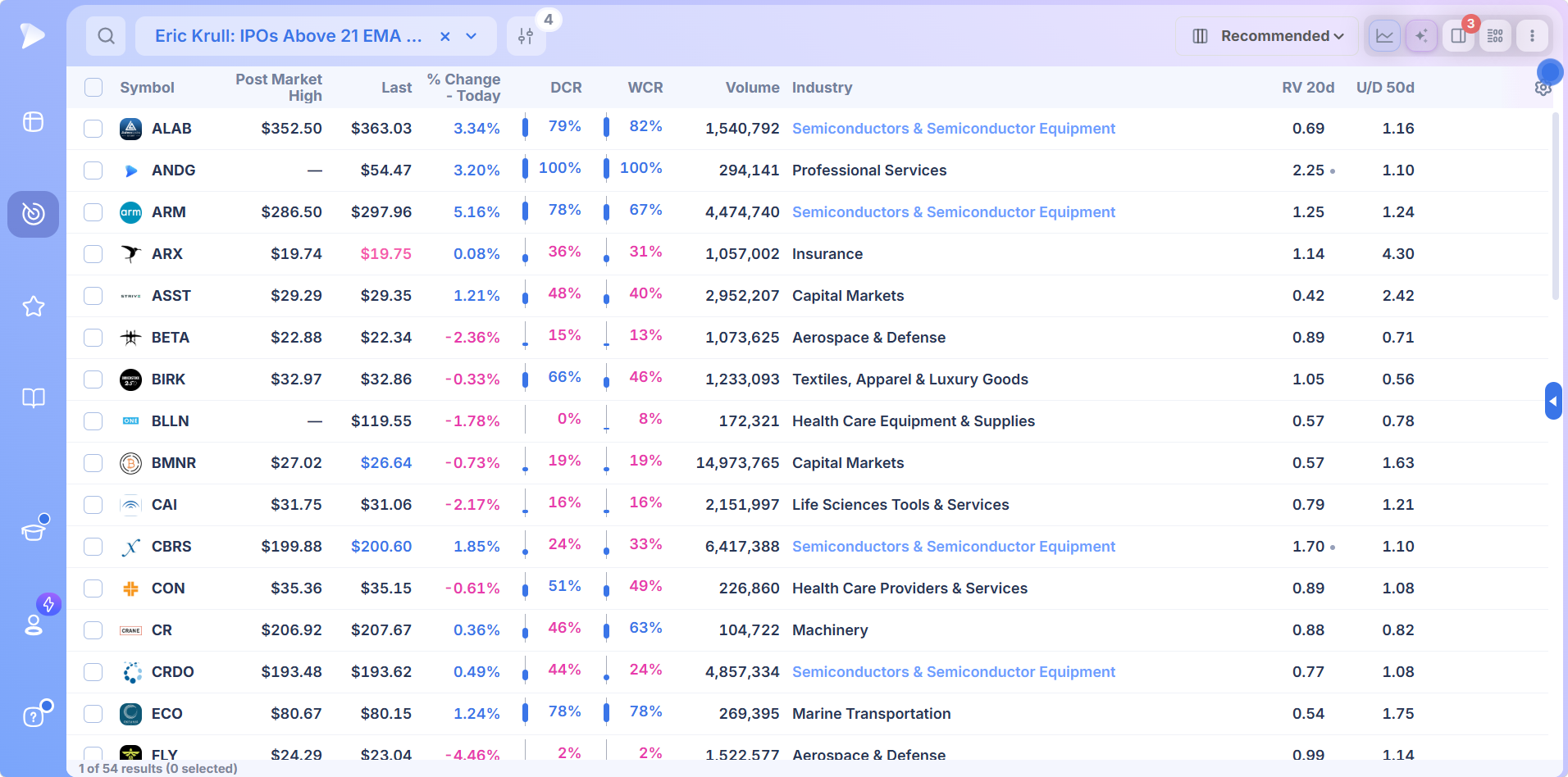
- ✓The preset returns liquid recent IPOs whose price is holding above the 21 period exponential moving average
- ✓The 21 EMA matters for new stocks because it is the first moving average with enough history to mean anything
- ✓Holding the line marks the IPO advance and institutional advance phases of the lifecycle; losing it usually marks the due diligence phase
- ✓The up/down ratio and relative volume show whether the hold is being funded or merely drifting
- ✓The trade is the first pullback to the 21 EMA or the breakout from the IPO base, with the stop at a close back below the line
- ✓One $49 a month plan covers the preset, Krull’s other IPO screens, charting, watchlists and alerts
What Is the IPOs Above 21 EMA Screen?
The preset description in the app reads: liquid recent IPOs successfully maintaining structural momentum above their 21 period exponential moving average. Each word in that sentence is a condition, and the word doing the most work is maintaining. The screen is not looking for the IPO that spiked yesterday. It is looking for the one that has been quietly closing above its trend line for weeks.
| Condition | What it requires | Why Krull includes it |
|---|---|---|
| Recent IPO | The stock listed recently enough to still be in its lifecycle phases | Older stocks have long term averages and full ownership; the edge is specific to new listings |
| Liquid | Enough dollar volume for a fund to build a position | Thin IPOs move on retail flow and give no read on institutional interest |
| Above the 21 period EMA | Price is closing above the exponential average of the last 21 sessions | The line that buyers defend during accumulation and abandon during distribution |
Why the 21 EMA and Not a Longer Average
A stock that listed four months ago has no 200 day moving average. Its 50 day average has existed for a few weeks and its 10 week line is still forming. The 21 period EMA, roughly one trading month, is the first average that a new listing can be measured against with any confidence, and because it is exponential it weights the most recent closes, which for a stock with almost no history is the only data worth weighting.
The 21 EMA meaning for an IPO trader is therefore practical rather than mystical. It is the shortest line that filters out day to day noise while still turning fast enough to catch a stock whose character has changed. Krull’s screen uses it as a pass or fail test, and the chart uses it as the reference for every entry and exit that follows.
Where the Screen Fits in the IPO Lifecycle
The Lifecycle Trade, which Krull wrote with Kathy Donnelly, Eve Boboch and Kurt Daill, maps the years after a listing into phases. The IPO advance is the initial run, sometimes days and sometimes months. The institutional due diligence phase follows, when the early advance stalls, lockups expire and large holders study the first quarterly reports before committing. The institutional advance is the sustained move that arrives once they do, and it is the phase that produces the largest gains.
Price relative to the 21 EMA tracks those phases closely. A stock that never gives up the line is still in its IPO advance. One that loses it and churns underneath is in due diligence. One that reclaims it after a long base and holds is beginning the institutional advance. The screen returns the first and third groups and drops the second, which is the group that costs IPO traders the most money.
Rocket Ships, Stair Steppers and the Rest
The same book sorts IPOs into archetypes by how they behave after listing: rocket ships that advance almost without pause, stair steppers that climb, base, and climb again, pump and dumps that top within weeks, disappointments that never recover their offering price, and one hit wonders that make a single run and fade. Only the first two spend meaningful time above the 21 EMA. The screen is, in effect, a filter for the archetypes worth owning.
Why Recent IPOs Break Most Stock Screeners
A generic screen assumes a stock has history. It asks for a rising 200 day average, a relative strength rating built from a year of returns, and several quarters of earnings growth. A stock that listed in the spring fails all three by default, not because it is weak but because the data does not exist yet. Run a standard momentum screen and the best new IPO stocks are excluded before a single condition is evaluated.
An IPO screener has to be written from what a young stock does have: an IPO date, a few weeks of price and volume, and a short moving average. Krull’s preset is built from exactly those, which is why it surfaces names the ordinary screens are blind to.
Why Deepvue Is the Best IPO Screener for the 21 EMA Setup
Deepvue carries an IPO date field, a 21 period EMA condition and the volume columns that make a hold readable, and Krull’s preset is built from them. Nothing has to be rebuilt.
Krull’s IPO Screens in the Preset Library
Open Screener Presets from the dropdown beside the screen name. Under Top Traders, Eric Krull has his own folder with three IPO screens, and IPOs Above 21 EMA is one of them, next to Elite IPOs and a third screen for new listings on the move. Hover the info icon and the description appears; select the row and the results replace the table.
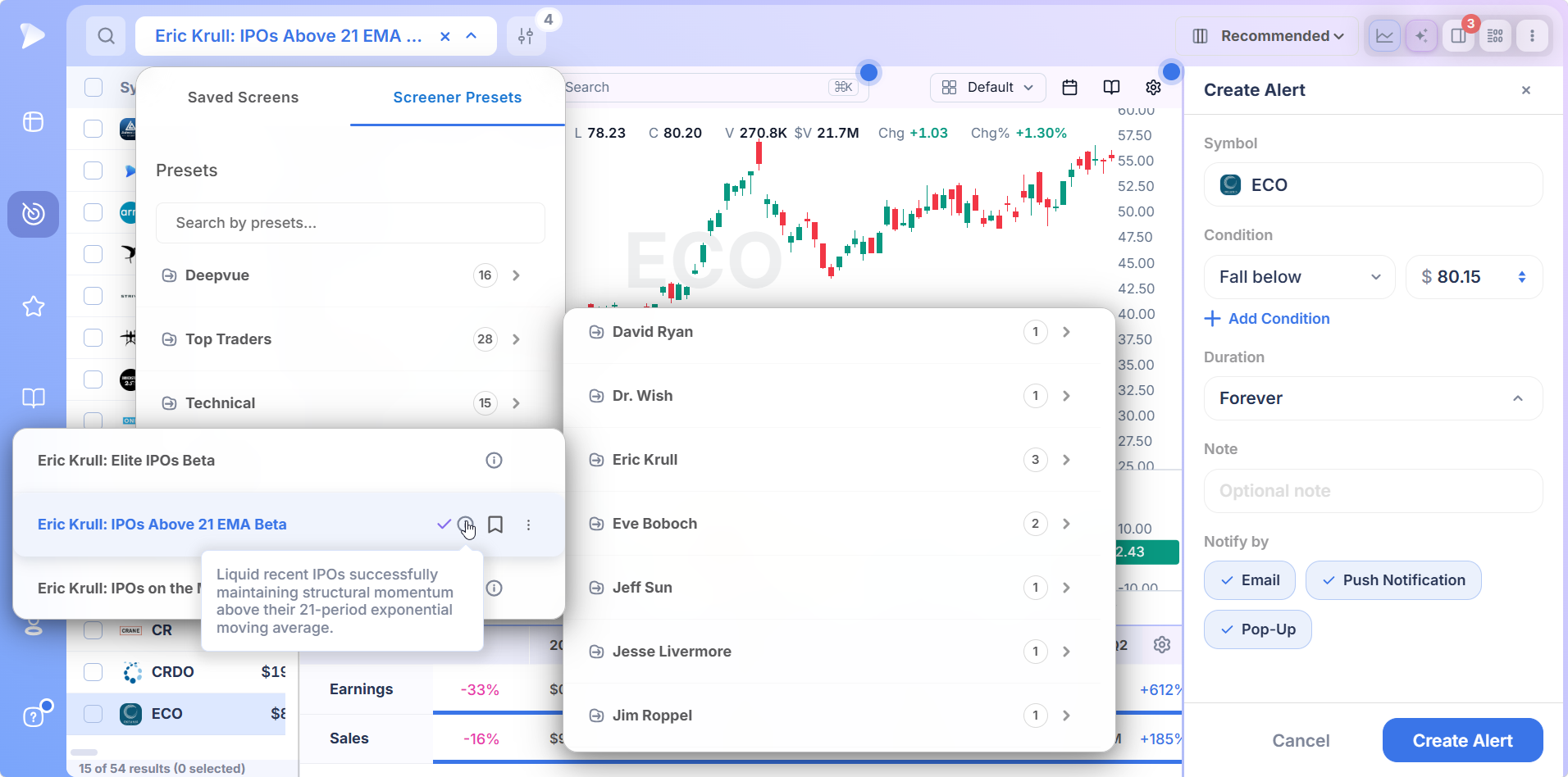
Presets are locked. Save one as your own and each condition opens for editing, including the IPO window and the EMA length.
Columns That Tell a Funded Hold From a Drift
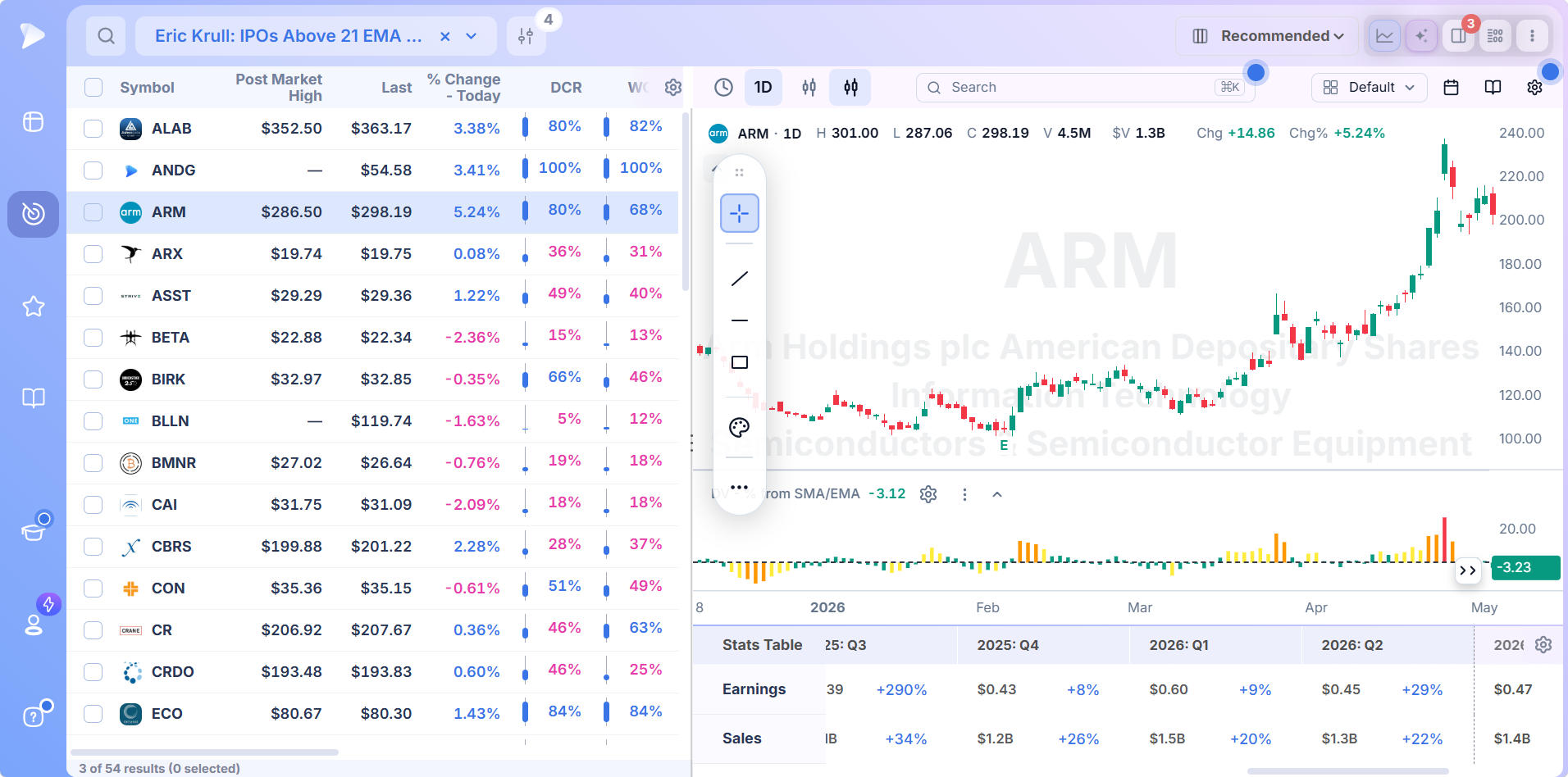
Two IPOs can both be above the 21 EMA and be in completely different situations. The recommended column set shows which is which. Daily and weekly closing range reveal whether the stock is finishing near its highs, the signature of buyers who keep pressing. Relative volume over 20 days shows whether recent sessions traded heavier than the stock’s own short norm. The ratio of up day to down day volume across 50 sessions compares the two sides of the tape, and for a stock with no long history it is the cleanest read of accumulation available.
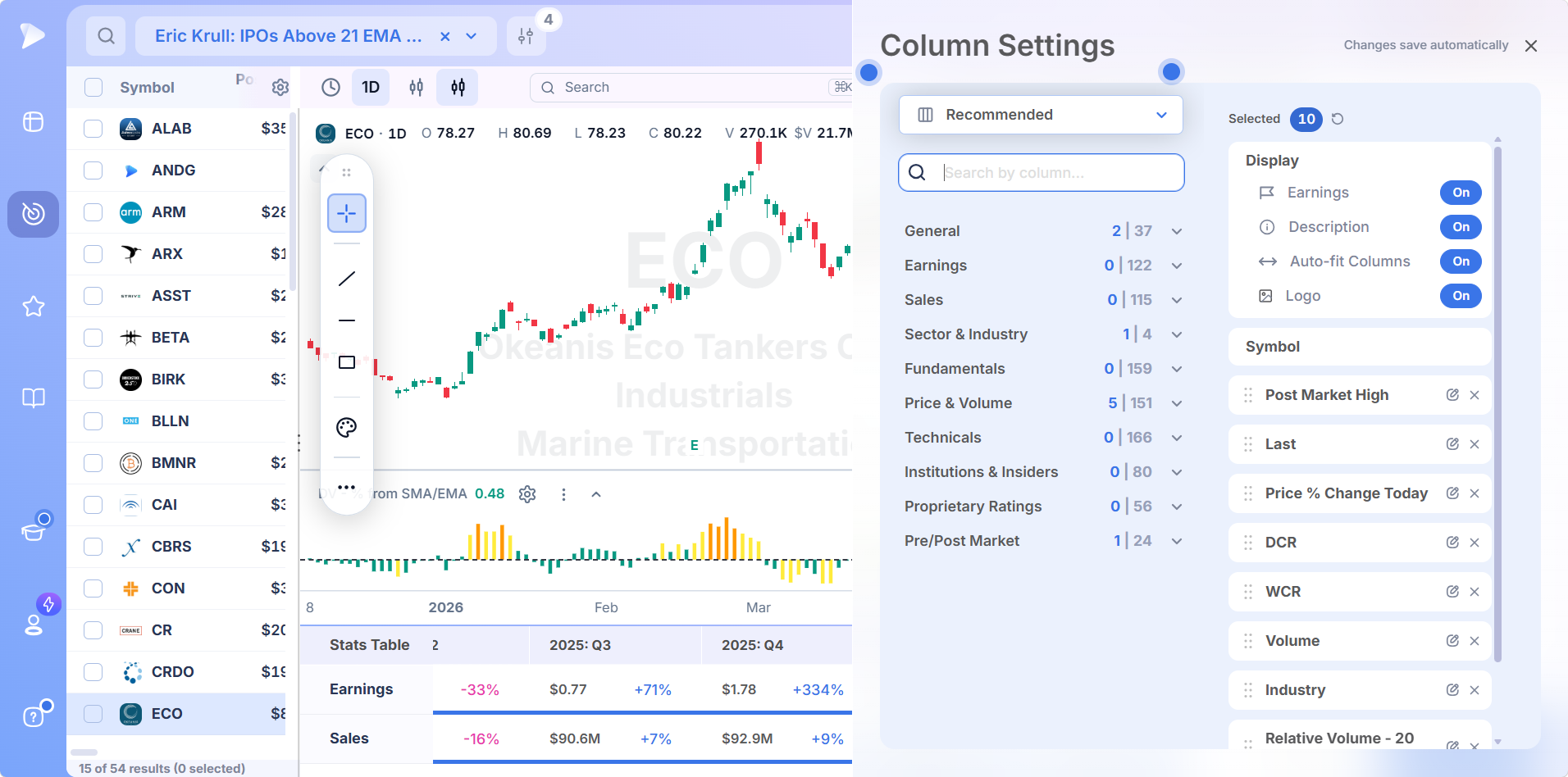
Sort by the up/down ratio and the IPOs where big money has been net buying rise to the top. Sort by relative volume and the ones waking up today do.
The Lifecycle Phase Is Visible on the Chart
Select any row and a split view chart appears beside the list. The candles since the listing show the whole lifecycle so far: the initial advance, any base, and how price has treated the 21 EMA on each test. A lower pane plots the percentage distance from the moving average, so a stock hugging the line and one stretched far above it are told apart at a glance.
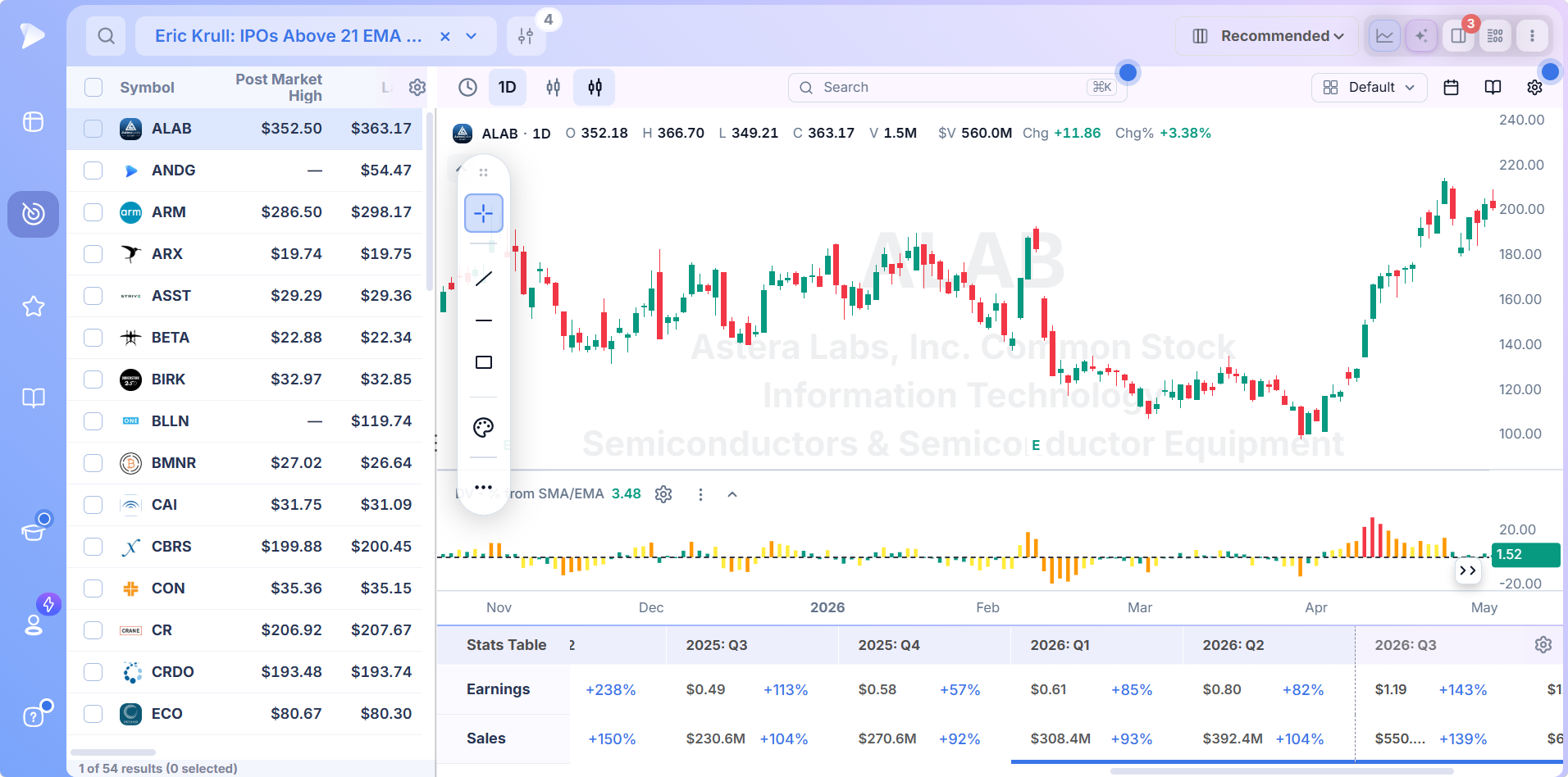
The stats table under the price carries quarterly earnings and sales with their growth rates. For an IPO, those first few quarters are what the due diligence phase is about, and seeing them without leaving the screener is what makes the check fast.
Alert the Line Instead of Watching It
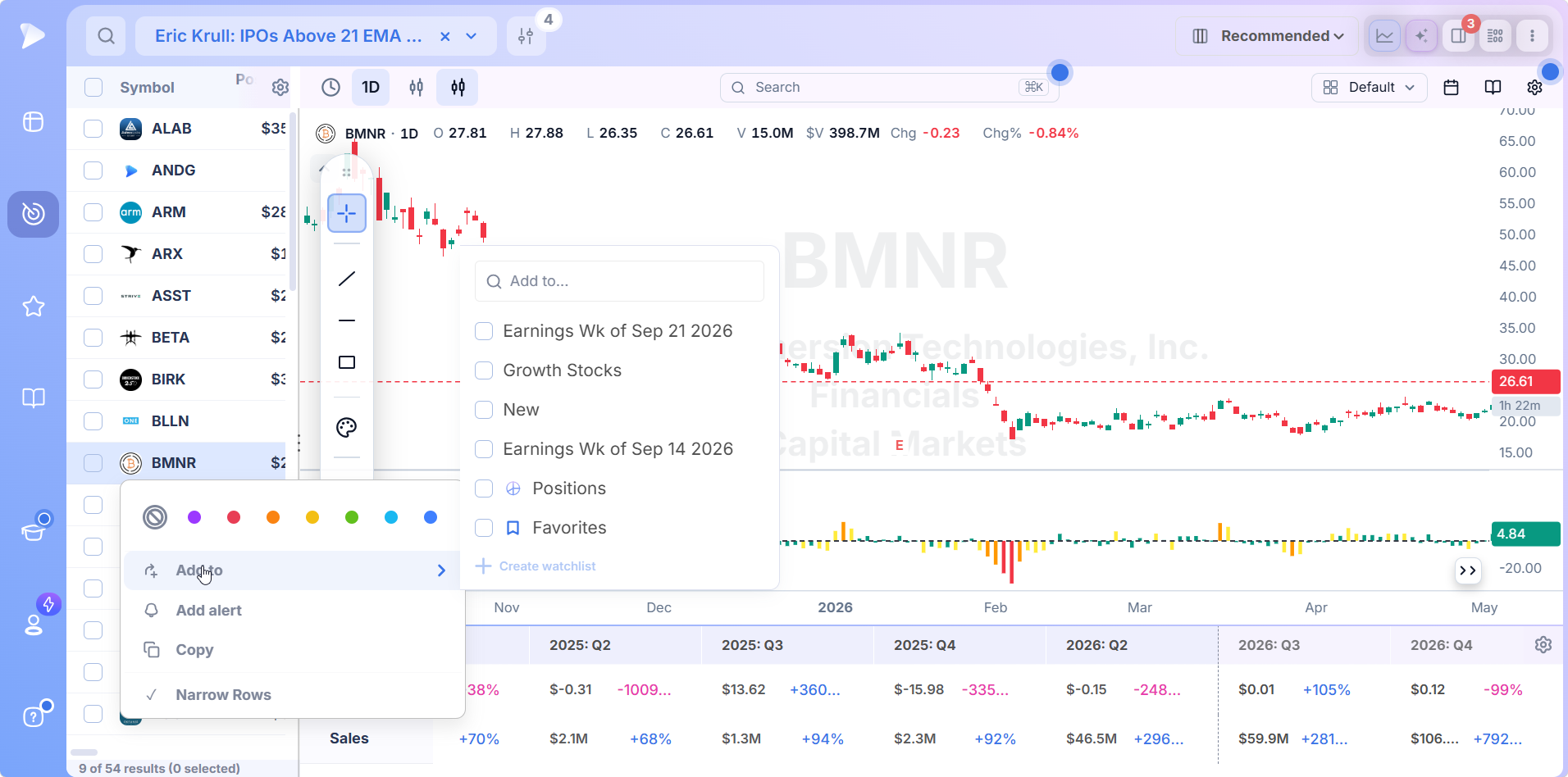
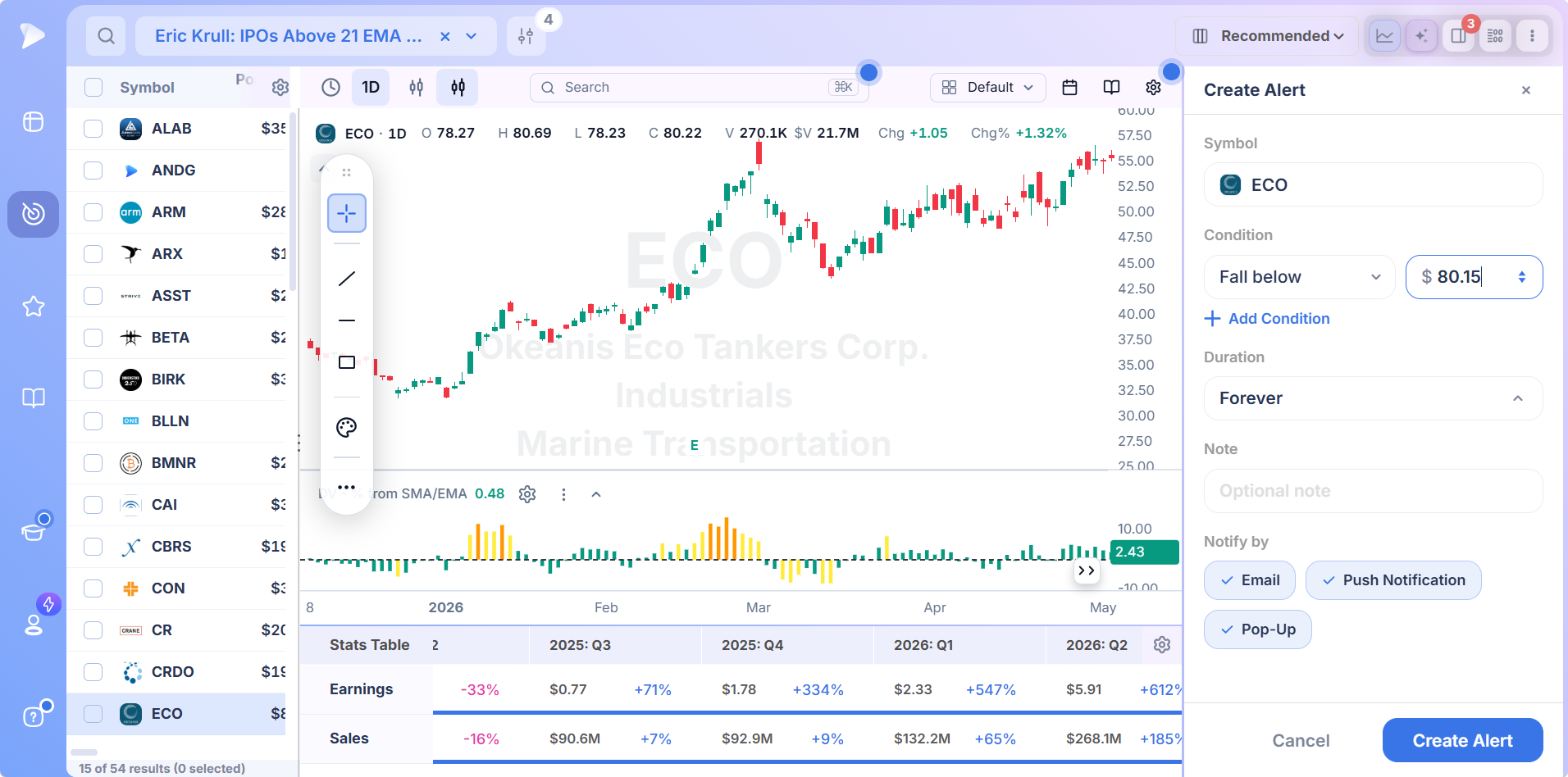
Right click a result to add it to a watchlist or to open an alert. For a stock that qualifies on the 21 EMA, the useful alert is a fall below the level where the hold would be broken, set once and left to run. If it never fires, the position is doing its job. If it does, the decision has already been made.
How to Build Your Own IPO Stock Screener
Krull’s preset is deliberately broad, since its job is to keep every candidate in view. A saved copy can narrow it to the exact phase you trade.
Copy the IPOs Above 21 EMA preset so the conditions open for editing.
Set the IPO date window to match your holding period, from the last 90 days for advance phase trades to the last two years for institutional advance breakouts.
Raise the liquidity floor to the average dollar volume your position size requires.
Cap the distance above the 21 EMA to remove stocks that have already run far from the line.
Require up day volume to exceed down day volume across 50 sessions so only accumulating names survive.
Add price within a set percentage of the post IPO high if you only want stocks near a breakout.
The AI Terminal accepts the same request in words: “stocks that IPOed in the last year, above the 21 EMA, within 10% of their high, up/down volume above 1.2” returns the conditions ready to save.
How to Trade IPOs Above the 21 EMA
The screen decides what to look at. Krull’s framework decides when to act, and it is built around the same moving average.
Entry: the First Pullback or the IPO Base Breakout
Two entries recur. The first is the initial pullback to the 21 EMA after the IPO advance, bought when price touches the line and closes back up off it, with the stop just below the low of that test. The second is the IPO base breakout: the stock spends weeks consolidating, often below its early high, then clears the top of the base on expanding volume. Either way, the 21 EMA should already be beneath price before the entry, which is exactly what the screen has confirmed.
Sizing for a Stock With No History
IPOs move more than seasoned stocks in both directions, so the same dollar risk buys fewer shares. The position size calculator turns the entry and the stop into a share count, and for a new listing it is worth starting smaller than the calculator allows and adding only after the first higher low.
Exit: the Close Below the Line
The exit rule is the entry rule in reverse. A daily close below the 21 EMA, particularly on heavier volume than the advance was built on, is the signal that the hold has ended and the due diligence phase may be starting. The discipline is to respect that close rather than hope for a reclaim, because reclaims happen, but the ones that don’t take the whole gain back. A climactic run far above the line into heavy volume is the other exit, taken into strength.
IPOs Above 21 EMA, Elite IPOs or Liquid IPOs?
Deepvue ships several IPO presets from the Lifecycle Trade authors, and they answer different questions:
- •IPOs Above 21 EMA. Krull’s trend test. Which recent listings are holding their line right now.
- •Elite IPOs. Krull’s second IPO preset, a narrower cut of the same universe.
- •Focus on Liquid IPOs. Kathy Donnelly’s screen, built on dollar volume, for the IPOs institutions can actually own.
- •The Next Apple. Eve Boboch’s fundamental screen for new listings growing fast enough to become the next leader.
The three presets from the other authors are compared at IPO screeners. The moving average condition on its own, applied to every stock rather than only IPOs, is covered by the exponential moving average stock screener. And because a new listing reporting its first strong quarter is a textbook catalyst, many of these names also appear on the Qullamaggie episodic pivot screener on the day they gap.
When an IPO Above the 21 EMA Should Be Ignored
Qualifying is necessary, not sufficient. Skip the result when:
- •It just listed. A stock a week old is above every average by definition. The 21 EMA needs at least a few weeks of data before holding it means anything.
- •The lockup expires soon. Insider lockups typically end about six months after the offering, and the supply that arrives can end a hold overnight. Check the date before the entry, not after.
- •Volume is fading on the hold. Price above the line on shrinking volume and a weak up/down ratio is a stock nobody is selling yet, which is different from one being bought.
- •It is far above the line. An IPO 40% above its 21 EMA is late in its advance. The pullback to the line is the entry, and it has not happened.
- •The first report is days away. The initial earnings release is the hinge of the due diligence phase. Holding a full position through it is a bet, not a trade.
Who Gets the Most From This Screen
- •Traders working from The Lifecycle Trade who want the authors’ screens rather than a reconstruction
- •Growth traders whose usual screens exclude recent listings for lack of history
- •Swing traders who buy the first pullback to a short moving average and want a list of new stocks that qualify
- •Anyone tracking the IPO calendar who needs a way to rank the listings after they start trading
- •Position traders waiting for the institutional advance and wanting the base breakouts flagged as they occur
Pricing
Deepvue is $49 a month, one plan, everything included.
- •All three of Eric Krull’s IPO presets together with the rest of the Top Traders library, editable once copied
- •IPO date, moving average distance and up/down volume as both columns and conditions, the fields an IPO screen depends on
- •Charts with the lifecycle visible from the first candle, plus quarterly earnings and sales beneath them
- •Watchlists and alerts, so the 21 EMA is monitored without a chart open
MarketSurge, the platform most IPO traders compare it with, is $149 a month.
New accounts include a setup call, introductory emails and weekly webinars that each take one module apart.
New Stocks, One Line, No Guesswork
The IPO market rewards the trader who can wait through the noise and recognize the moment institutions commit. Krull’s screen does not predict that moment, but it keeps every candidate in front of you until it arrives, and drops the ones that have already failed the test. That is the whole job of an IPO screener, and the 21 EMA does it with one condition.
Krull’s other two IPO screens and the presets from 27 more traders are indexed at stock screener by trader. Chart formation screens are collected at stock screener by pattern, the session clock screens are at stock screener by market timing, while the signal driven screens are at stock screener by indicator.
Run the IPOs Above 21 EMA screen tonight
↑ Back to contentsFrequently Asked Questions
What does the IPOs Above 21 EMA screener look for?
The IPOs Above 21 EMA screener looks for liquid recent IPOs whose price is holding above the 21 period exponential moving average, which the preset description calls maintaining structural momentum. It is Eric Krull’s own screen and ships under Top Traders in Deepvue.
Who is Eric Krull?
Eric Krull is a full time trader since 1999 and one of the four authors of The Lifecycle Trade, the study of how IPOs and super growth stocks behave after listing. Three of his IPO screens are presets in Deepvue, including IPOs Above 21 EMA and Elite IPOs.
What is the 21 EMA in trading?
The 21 EMA in trading is the exponential moving average of the last 21 closes, about one trading month, weighted toward the most recent sessions. IPO traders use it because it is the first moving average a new listing has enough history to support, and Deepvue offers it as both a chart line and a screen condition.
Why use the 21 EMA for IPO stocks instead of the 50 or 200 day?
The 21 EMA is used for IPO stocks because a recent listing has no 200 day average and often no reliable 50 day either. The 21 period line exists within weeks of the offering, turns quickly enough to reflect a change in character, and is the level buyers defend during accumulation.
What is the institutional due diligence phase?
The institutional due diligence phase is the period in The Lifecycle Trade framework after the IPO advance stalls, when lockups expire and large investors study the first quarterly reports before buying in size. Stocks in it usually trade below the 21 EMA, which is why Krull’s screen drops them.
How do you trade IPOs with this screen?
You trade IPOs with this screen by buying either the first pullback to the 21 EMA after the initial advance or the breakout from the IPO base, with a stop under the test low or the base low. The exit is a daily close back below the 21 EMA, and Deepvue’s alerts can watch that level for you.
What is an IPO base?
An IPO base is the consolidation a new stock forms after its first advance, often lasting several weeks and frequently below its early high. A breakout from the base on rising volume, with price already above the 21 EMA, is one of the two entries the Lifecycle Trade authors trade, and the screen keeps those candidates in view.
How recent does an IPO have to be for the screen?
The preset applies its own recent IPO window, and a saved copy lets you set the IPO date condition to any range, from the last 90 days to the last two years. Shorter windows target the IPO advance, and longer windows catch the institutional advance that can begin a year or more after the listing.
Does the screen show whether institutions are buying an IPO?
Yes, the screen shows whether institutions are buying an IPO through the columns beside each result rather than the condition itself. The up/down volume ratio, 20 day relative volume and closing range together reveal whether the hold above the 21 EMA is being funded by heavy buying or simply drifting.
Is IPO trading profitable?
IPO trading is profitable for traders who are selective, since the biggest winners of most cycles start as recent listings, but most IPOs lose ground after their initial advance. A screen that requires liquidity and a hold above the 21 EMA removes a large share of the losers before any chart is opened.
Can the IPOs Above 21 EMA preset be customized?
Yes, the IPOs Above 21 EMA preset can be customized after you save a copy, which opens every condition for editing. Common changes are a narrower IPO window, a higher dollar volume floor, a cap on distance above the 21 EMA and an up/down volume ratio minimum.