The Bull Snort Screener Built on Oliver Kell’s Volume Rule
A bull snort is Oliver Kell’s name for a day when a liquid stock surges on far more volume than it normally trades, which he reads as institutions showing their hand. Deepvue’s bull snort screener is his own preset: stocks up more than 3% on at least three times their normal volume. Kell logs every one to a list because the big volume day is where future opportunities come from, even when the trade isn’t today. $49 a month.
Key Takeaways
Institutions can’t buy a meaningful position quietly. A fund taking a stake has to trade a multiple of the stock’s normal daily volume, and that shows up on the tape as a single loud day: price up, volume several times average, a candle that stands out on the chart. Oliver Kell, who returned 941% to win the 2020 U.S. Investing Championship, calls that day a bull snort, and it is the first thing his daily scan looks for.
The Oliver Kell trading strategy starts from a simple observation. Big volume today means somebody with size cares, and somebody with size usually keeps buying. Deepvue’s screener ships the Oliver Kell Bull Snorts preset so the scan he runs every session is one click for you, and what’s left is deciding which snorts belong on your list.
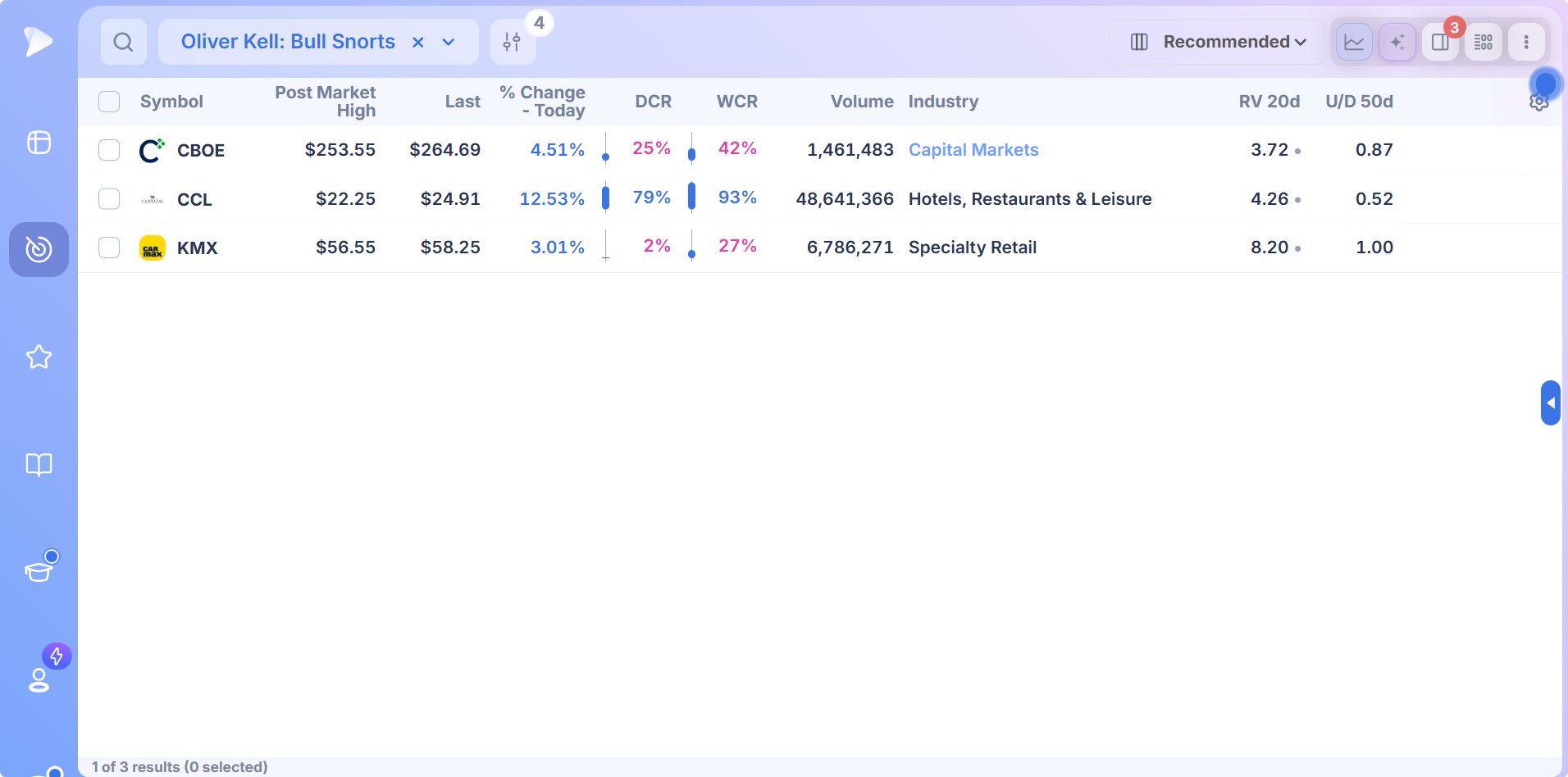
- ✓A bull snort is a strong up day on a multiple of normal volume, and Kell treats it as a footprint of institutional buying
- ✓The preset tests liquidity, a move above 3% and volume at least three times the stock’s own average
- ✓Relative volume, not raw volume, is the measure, so a small cap on 3x is as much a snort as a mega cap on 3x
- ✓Kell adds snorts to a watchlist first and trades them later, when the cycle of price action offers an entry
- ✓The 10 and 20 day exponential averages decide the entry, the stop and the exit for everything on the list
- ✓One $49 a month plan covers the preset, the relative volume columns, charting and alerts
What Is a Bull Snort?
Oliver Kell coined the term for the stocks that make his list every day: names that just traded a big multiple of their normal volume while price pushed higher. The image is a bull snorting before it charges. The move hasn’t necessarily started, but the animal has announced itself.
Kell has said publicly that when the number of bull snorts being added to his list each day grows, he treats it as a meaningful sign for the market as a whole, because big volume equals future opportunities even when he doesn’t play them right out of the gate. That sentence is the whole strategy. The snort is a nomination, not an order.
What Makes the Volume Meaningful
Raw share count means nothing on its own. A stock that trades 50 million shares a day doing 60 million is a normal Tuesday. A stock that trades 400,000 shares a day doing 1.5 million has just seen a buyer who is not usually there. That is why the bull snort test is relative volume: today against the stock’s own recent average.
| Condition | What it checks | Why it is in the screen |
|---|---|---|
| Liquid stocks | Enough dollar volume that the day’s buying could be institutional | A 3x day in an illiquid name can be one retail order |
| Up more than 3% | Price closed meaningfully higher, not just churned | Volume with no price progress is as likely distribution as accumulation |
| At least 3x normal volume | Today’s volume against the stock’s recent daily average | This is the snort: the size that gives the buyer away |
Three times is the floor. The snorts that turn into the biggest moves are often five, eight or ten times average, and the relative volume column in the results lets you sort for them.
Where a Bull Snort Falls in the Cycle of Price Action
Kell’s framework for reading a chart, often called the Oliver Kell price cycle, is the cycle of price action, a sequence every trending stock passes through in some form: a reversal extension off the lows, a wedge pop back through the 10 and 20 day exponential moving averages, an EMA crossback as those averages turn up, a base and break where price consolidates and resumes, and eventually an exhaustion extension when the stock runs too far above the averages and climaxes.
A bull snort can appear at almost any point in that sequence, and where it appears changes what it means:
- •Early in the cycle, a snort out of a low base or on the wedge pop is the first evidence institutions have arrived. These are the ones worth the most attention.
- •Mid cycle, a snort on a base and break confirms the trend is being funded and gives a fresh entry off the pivot.
- •Late in the cycle, a snort far above the moving averages is often the exhaustion extension itself, the day the last buyers pile in. Same screen result, opposite meaning.
The screen can’t tell those apart. The chart can, in about two seconds, which is why every result opens next to one.
Why Kell Lists First and Trades Later
Chasing the snort day itself is the classic mistake. Price is already up 5% or 10%, the low of the day is far below, and the stop is wide. Kell’s approach is to put the name on a watchlist, wait for it to digest the volume, and enter when the cycle offers a tight setup: a pullback to the 10 or 20 day EMA, a wedge pop, or a break from a short base. The snort qualifies the stock. The setup times the trade. Separating the two is what makes the pattern usable.
Why Volume Surges Are Easy to Find and Easy to Misread
Any high volume stock screener can rank stocks by share count. Most unusual volume lists are useless for exactly that reason: they are dominated by mega caps having a slightly busy day, penny stocks with a promotional spike, and names that gapped down on bad news. None of those are bull snorts.
The preset removes each of those. The liquidity floor drops the promotions. The 3% price condition drops the sell offs. The relative measure drops the mega caps that merely traded a lot in absolute terms. What survives is the short list of bull snort stocks where someone with size bought aggressively today, which is the list Kell actually reads.
Why Deepvue Is the Best Oliver Kell Bull Snort Screener
Kell built his screens in Deepvue, so this Oliver Kell screener isn’t an approximation of his scan. It is his scan, next to the other four he runs, with the columns that let you rank snorts by size and the chart that tells you where each one falls in the cycle.
An Oliver Kell Screener That Ships in the App
Screener Presets is reached from the menu on the current screen’s name. Under Top Traders, Oliver Kell’s screens are grouped together. Bull Snorts is one of five screens inside it, alongside 52 Week Highs, Doublers, Gappers and Strength on Down Day. Pick it and the day’s snorts fill the table.
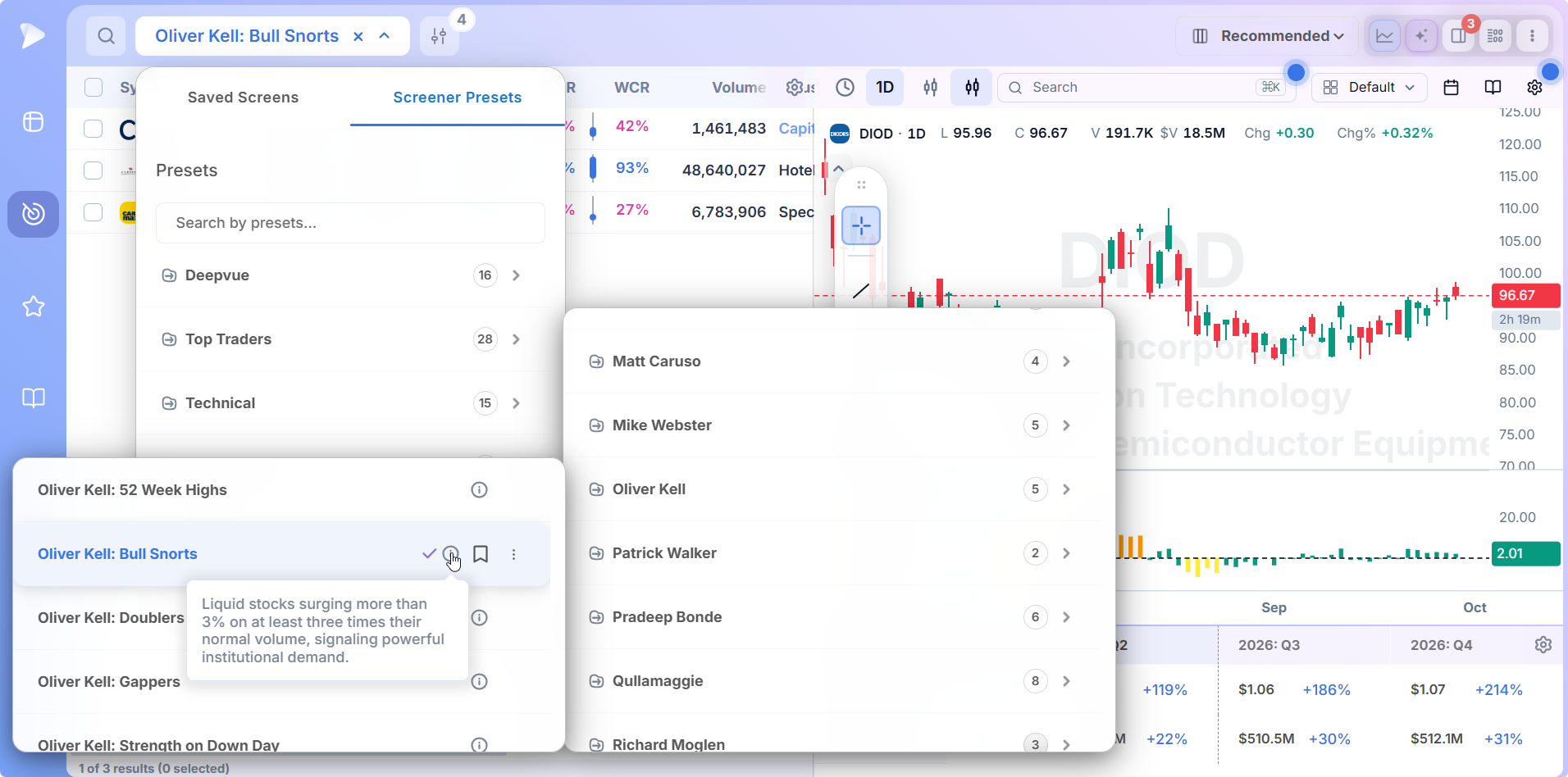
The stock preset is protected from edits. Save a copy under your own name and every condition opens up.
Sort by Relative Volume, Not by Volume
The column that makes this screen work is 20 day relative volume, today’s volume as a multiple of the trailing average. Sort the results by it and the biggest snorts rise to the top regardless of share count. Add daily and weekly closing range beside it: a snort that closed near its high was bought into the close, while one that closed in the bottom third was sold into, and Kell would treat those very differently.
The 50 session up/down volume ratio completes the picture. A snort in a stock whose up days have already been outpacing its down days is an accumulation pattern getting louder. A snort in a stock with heavy recent selling is more often a squeeze.
The Cycle Stage Is on the Chart Beside the Row
Click a result and the chart opens next to the list. The snort candle is obvious, and so is what surrounds it: is price coming out of a long decline, pushing through the 10 and 20 day EMAs, breaking a base, or stretched far above both lines? That read is the difference between a name that goes on the list and one that gets skipped.
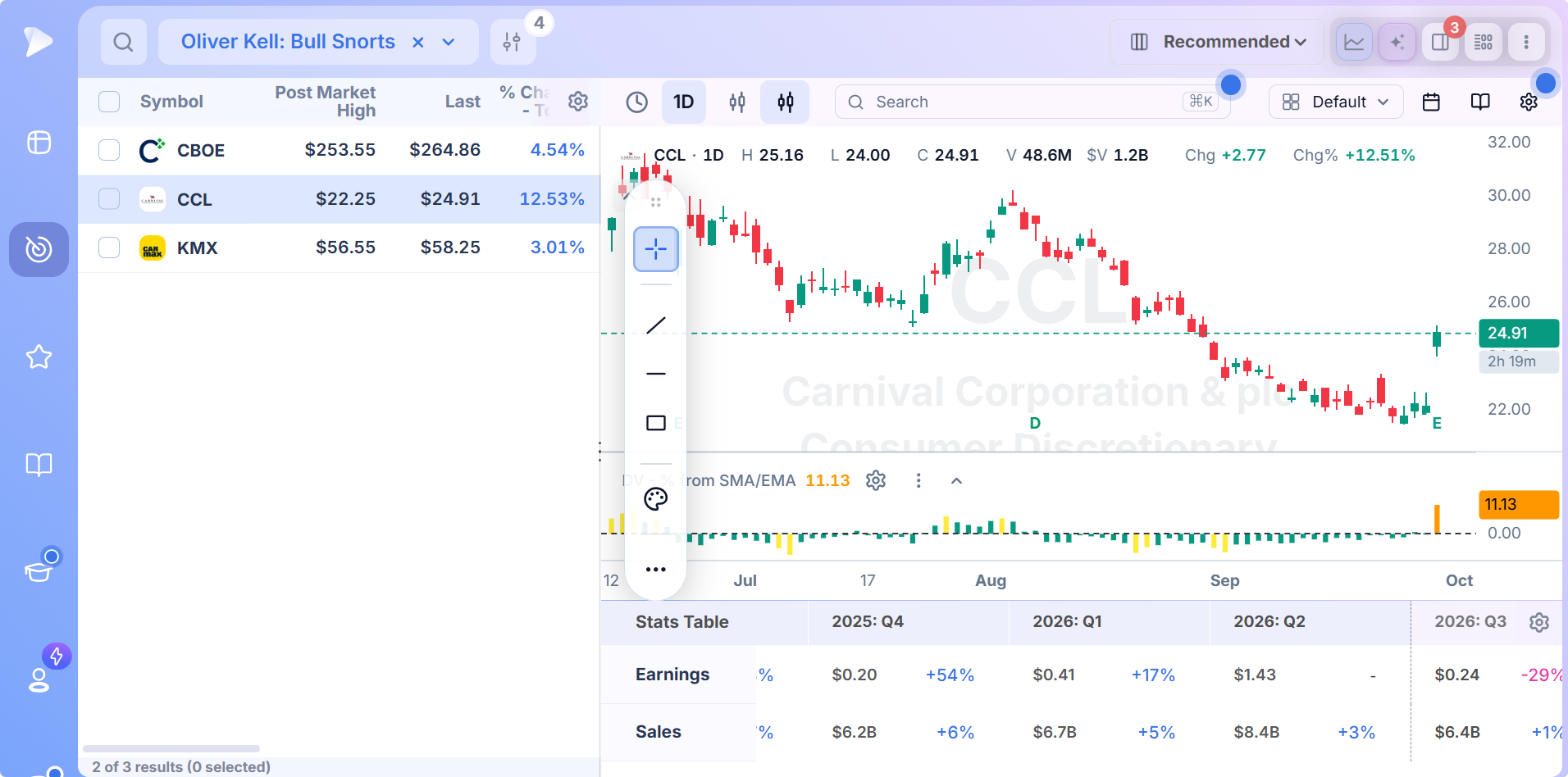
The stats table beneath the candles carries the quarterly earnings and sales figures, which is how you check whether the volume arrived on a fundamental catalyst or on nothing at all.
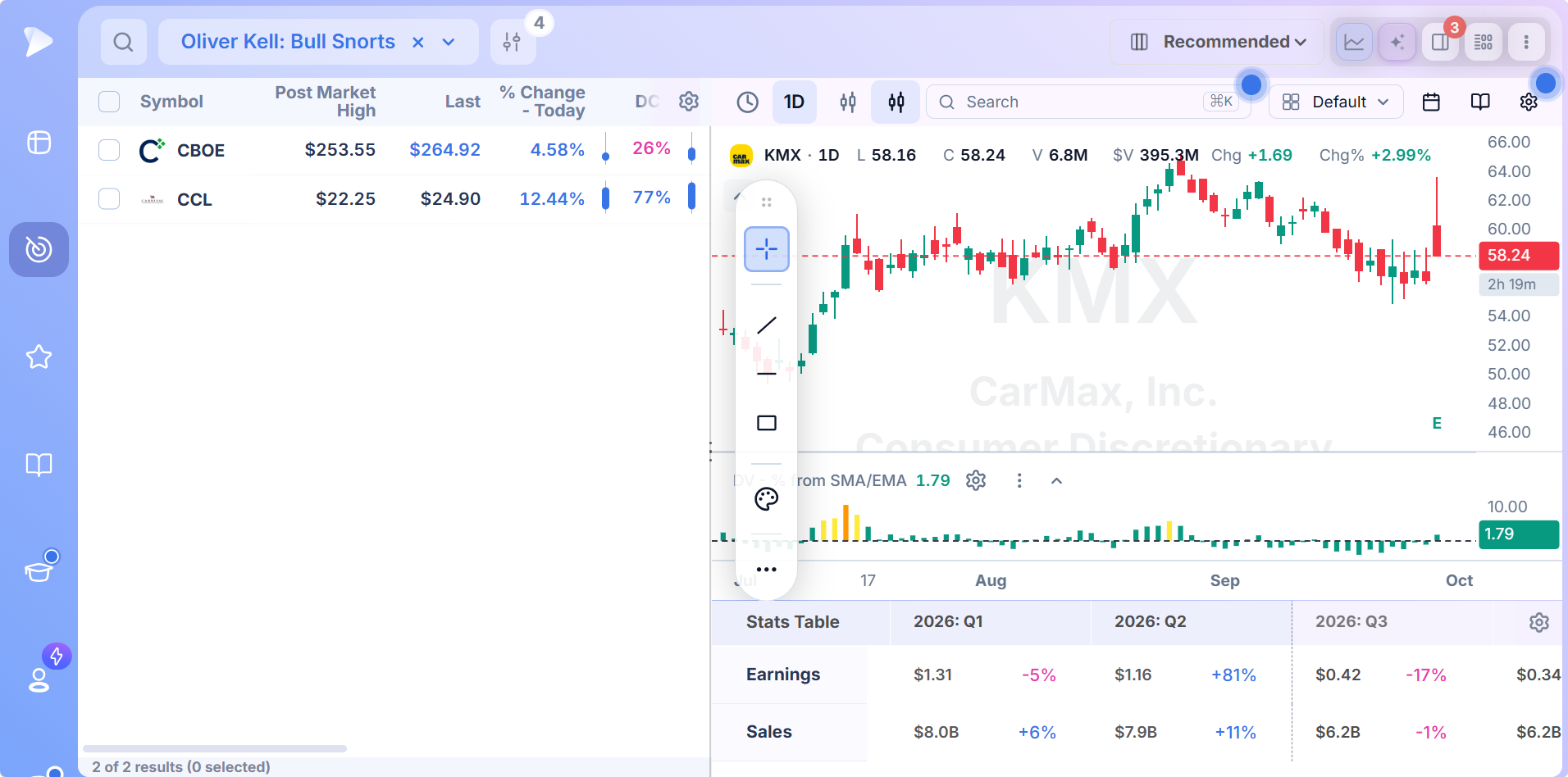
List It, Then Alert the Setup
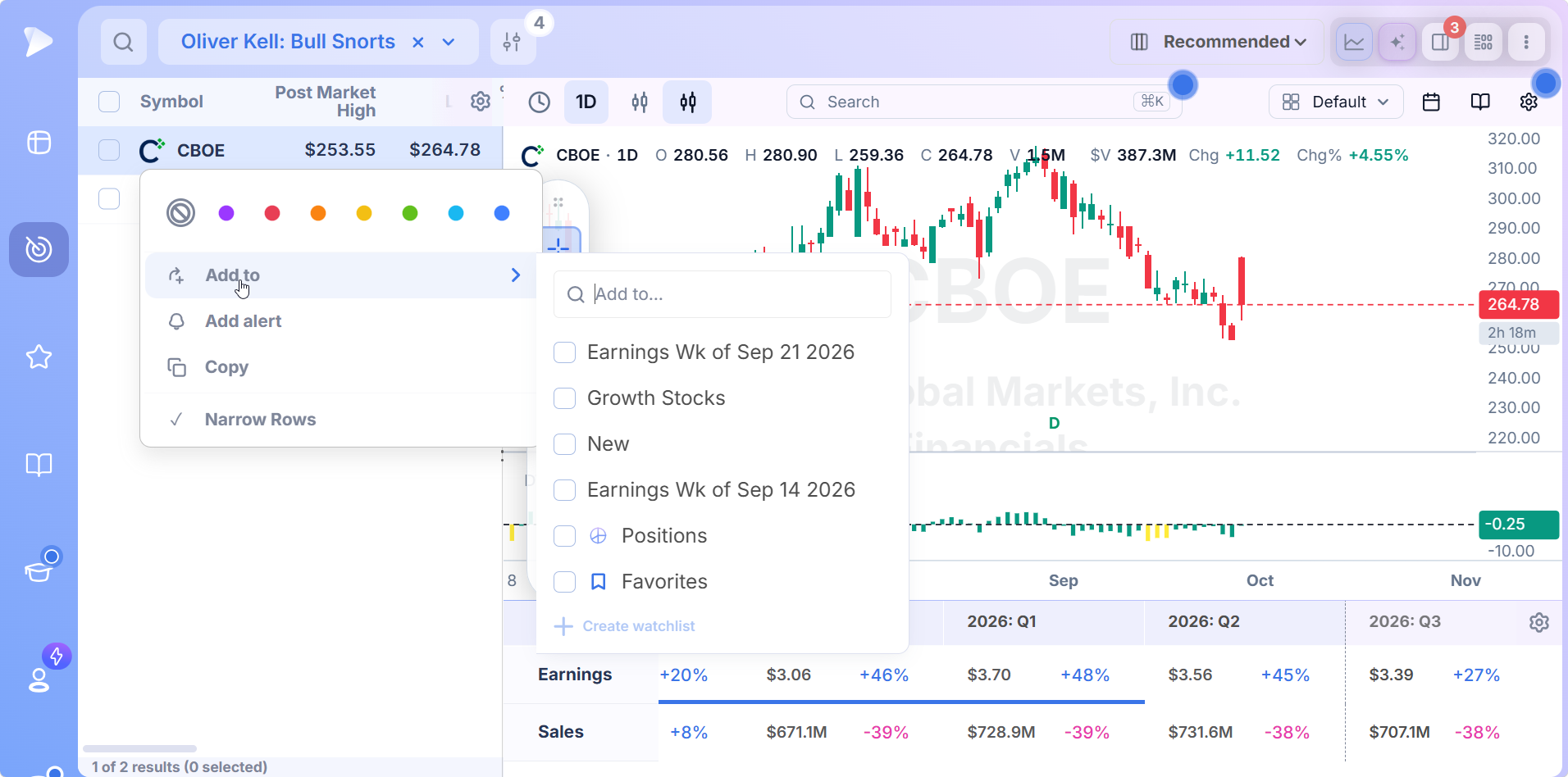
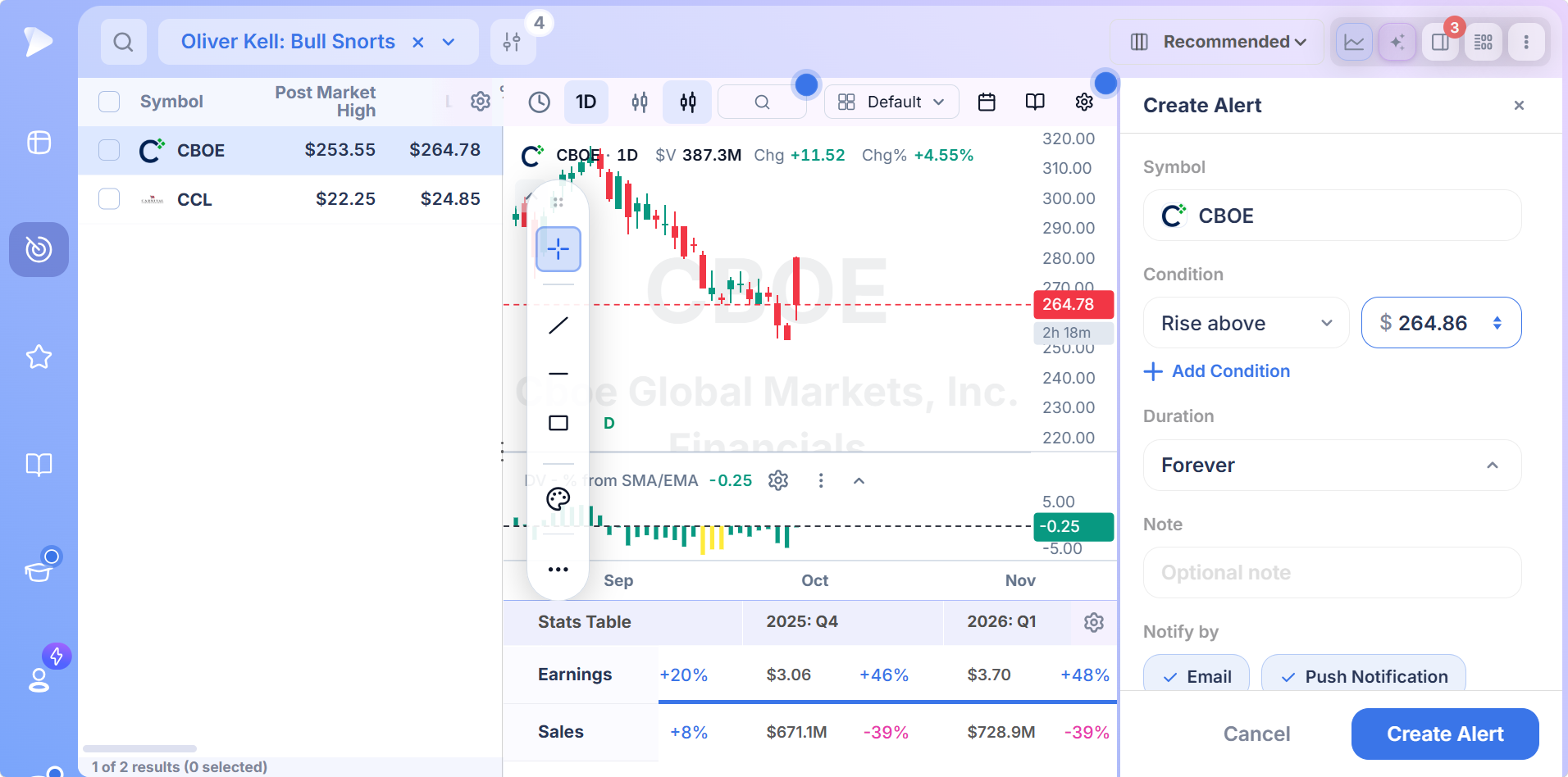
Kell’s process is list first, trade later, and Deepvue is built for that order. Right click a snort to drop it into a watchlist, then set an alert for the setup you are waiting for: a rise above the snort day’s high, or a touch of the 10 or 20 day EMA. When it fires, the chart has done the digesting and the entry has a tight stop underneath it.
How to Build Your Own Bull Snort Screener
The shipped preset is Kell’s starting point. A saved copy lets you make it stricter or point it at a specific part of the cycle.
Copy the Oliver Kell Bull Snorts preset, which makes the conditions editable.
Raise relative volume to 5x or more if you only want the loudest snorts, or leave 3x and sort the column instead.
Require a closing range of 70% or better, so only snorts that were bought into the close survive.
Add price above the 20 day EMA for mid cycle snorts, or price below it for the early reversal ones, depending on which you trade.
Cap the distance above the 50 day moving average to drop the exhaustion snorts stretched far from the averages.
Add an earnings date condition if you want to separate earnings driven snorts from the rest.
Or describe it to the AI Terminal: “liquid stocks up 3% on 5x volume, closing in the top quarter of the range, within 10% of the 50 day average” comes back as an editable condition set.
How to Trade a Bull Snort
Kell’s rules for what happens after the scan are as specific as the scan itself, and they revolve around two moving averages.
Entry Off the 10 and 20 Day EMAs
After the snort, the stock either keeps running, in which case it’s extended and Kell waits, or it pulls back and consolidates. The entry comes when price returns to the 10 or 20 day exponential moving average and holds, or when it breaks out of the short base the pullback formed. Buying the first higher low after the snort, rather than the snort itself, is where the risk reward is.
Where the Stop Goes
If buying a breakout, the breakout pivot or the day’s low. If buying off support at the EMA, the low of that bounce. Kell’s principle is that when the reason for buying is no longer present, he exits, and the position size calculator sets the share count from that stop so the loss is the same size whichever setup triggered.
Trailing the Winner
Kell uses the 10 and 20 day EMAs as a trailing stop. A stock that has been trending for weeks tells you which of the two matters: some ride the 10 day and are sold on the first close below it, others respect the 20 day and get more room. When the stock stretches far above both lines on a climactic volume day, that is the exhaustion extension, and it is a sell signal, not a fresh snort.
Bull Snort, Gapper or Episodic Pivot?
Three volume driven screens that overlap on busy days and differ in what they ask for:
- •Bull snort. Up 3% or more on 3x volume. No gap required, no catalyst required. The broadest net, and a list building tool.
- •Gapper. Kell’s screen for stocks that opened well above the prior close. A snort with a gap.
- •Episodic pivot. A 10% plus gap on a repricing catalyst from a neglected stock, traded the same day off the opening range.
The Qullamaggie episodic pivot screener covers the third. Kell’s own guide to his five screens, including the Gappers preset, is at Oliver Kell screens. A snort often shows up on all three lists at once, and the one worth trading is decided by the chart.
When a Bull Snort Should Be Ignored
The screen nominates. These are the nominations to decline.
- •A weak close. Heavy volume that finished in the lower half of the range means the buying met selling. Closing range below 50% is a different day.
- •Already extended. A snort 30% above the 20 day EMA after a long run is more likely the climax than the start.
- •Barely liquid. If dollar volume on the snort day is still small in absolute terms, no institution was involved and the pattern doesn’t apply.
- •Distribution underneath. A low up/down volume ratio going into the snort says sellers have been in control. One loud day rarely reverses that.
- •A hostile market. Kell scales exposure to the index. In a correction the list still fills, and most of the names on it fail.
Who Gets the Most From This Screen
- •People running Oliver Kell’s process who want his daily scans without rebuilding them
- •Swing traders who build a watchlist from volume events and trade the pullback, not the spike
- •Anyone who wants an unusual volume list that excludes the noise most volume screens are full of
- •Traders who read the cycle of price action and want each snort placed on the chart automatically
- •Watchlist builders who want the list to refresh itself every session
Pricing
$49 a month on a single plan, nothing gated.
- •Every Top Traders screen, Kell’s five included, open to edit once copied
- •Relative volume, closing range and up/down volume as columns and filters, so snorts can be ranked as well as found
- •Charts, lists, alerts and layouts that persist, the tools for list first, trade later
- •Streaming data during the session, so a snort forming at 11:00 is on the list at 11:00
The comparable platform, MarketSurge, is $149 a month.
New accounts include a setup call, introductory emails and weekly webinars that each take one module apart.
Follow the Volume, Trade the Setup
The tape only lies in one direction. A stock can rise on thin volume and mean nothing, but it can’t rise on three times its normal volume without someone big doing the buying. A bull snort screener finds those days across the whole market, and Kell’s method turns them into a list that pays off over the following weeks rather than a chase on the day.
Kell’s other four screens and the rest of the Top Traders presets are collected at stock screener by trader. Screens that key off a chart formation are at stock screener by pattern, and the approach based screens are at screener by strategy.
Run the Bull Snorts screen after the close
↑ Back to contentsFrequently Asked Questions
What is a bull snort in trading?
A bull snort in trading is Oliver Kell’s term for a day when a liquid stock rises sharply on a multiple of its normal volume, which he reads as a sign of institutional buying. Deepvue’s Bull Snorts preset screens for stocks up more than 3% on at least three times average volume.
What does bull snort mean?
Bull snort means a stock has announced itself with a burst of volume, the way a bull snorts before it charges. The move may not have started, but a large buyer has shown up. Oliver Kell adds every bull snort to a watchlist and trades the setup that follows.
Who is Oliver Kell?
Oliver Kell is a swing trader who won the 2020 U.S. Investing Championship with a 941% return, built on his cycle of price action framework and daily scans for bull snorts, 52 week highs and gaps. Five of his screens ship as presets in Deepvue, including Bull Snorts.
What does the Oliver Kell Bull Snorts screener on Deepvue look for?
The Oliver Kell Bull Snorts screener on Deepvue looks for liquid stocks surging more than 3% on the day on at least three times their normal volume. Save a copy of the preset and the thresholds can be raised or combined with closing range and moving average conditions.
How much volume makes a bull snort?
A bull snort needs volume at least three times the stock’s recent daily average, measured as relative volume rather than raw shares, so the test is fair across large and small stocks. Deepvue’s preset uses 3x as the floor and the relative volume column lets you sort for the 5x and 10x days.
Should you buy a bull snort the day it happens?
No, you should usually not buy a bull snort the day it happens, because price is extended and the stop is far away. Kell lists the stock and enters later on a pullback to the 10 or 20 day EMA or a break from a short base. Deepvue’s alerts fire when that setup arrives.
What is Oliver Kell’s cycle of price action?
Oliver Kell’s cycle of price action is the sequence a trending stock moves through: reversal extension, wedge pop, EMA crossback, base and break, and exhaustion extension, all read against the 10 and 20 day exponential moving averages. Where a bull snort falls in that cycle decides whether it is an entry or a warning.
How do you find stocks with unusual volume today?
You find stocks with unusual volume today by screening for relative volume, today’s volume against the stock’s own average, rather than raw share count, and filtering for liquidity and a positive close. Deepvue’s Bull Snorts preset applies all three and updates during the session.
Where does the stop go on a bull snort trade?
The stop on a bull snort trade goes under the breakout pivot or the day’s low when buying a breakout, and under the low of the bounce when buying off the 10 or 20 day EMA. Kell exits whenever the reason for the trade is gone, and an alert at that level does the watching for you.
Is a bull snort the same as a gap up?
A bull snort and a gap up are different things, though the two overlap. A bull snort is defined by relative volume and a 3% gain and needs no gap. A gap up is defined by the open versus the prior close. Deepvue ships Kell’s Gappers preset separately from Bull Snorts.
Can the Bull Snorts preset be customized?
Yes, the Bull Snorts preset can be customized once you save a copy, which unlocks every condition. Common additions are a higher relative volume floor, a closing range minimum, a moving average condition to target one part of the cycle, and an earnings date filter.