After Hours Stock Screener: Read Tonight’s Reactions First
An after hours stock screener works the evening session, roughly 4:00pm to 8:00pm Eastern, judging stocks on what they do after the closing bell rather than on the close itself. All 24 extended hours fields sit alongside the technicals, ratings and earnings history in Deepvue, so tonight’s reporters surface, the reaction gets sized, and tomorrow’s plan is written before bed. Single plan, $49 a month.
Key Takeaways
Four o’clock is not the end of anything. It starts the loudest two hours the market has. Most quarterly reports drop within minutes of the close, conference calls quietly rewrite whatever the headline said, and buyouts, share offerings and index changes get announced to a market that has already shut its doors.
Deepvue’s screening engine gives that window the same treatment as every other. Everything the evening produces becomes a filter, so you can catch a reaction, size it, and test it against the record underneath while the rest of the market waits to read about it tomorrow.
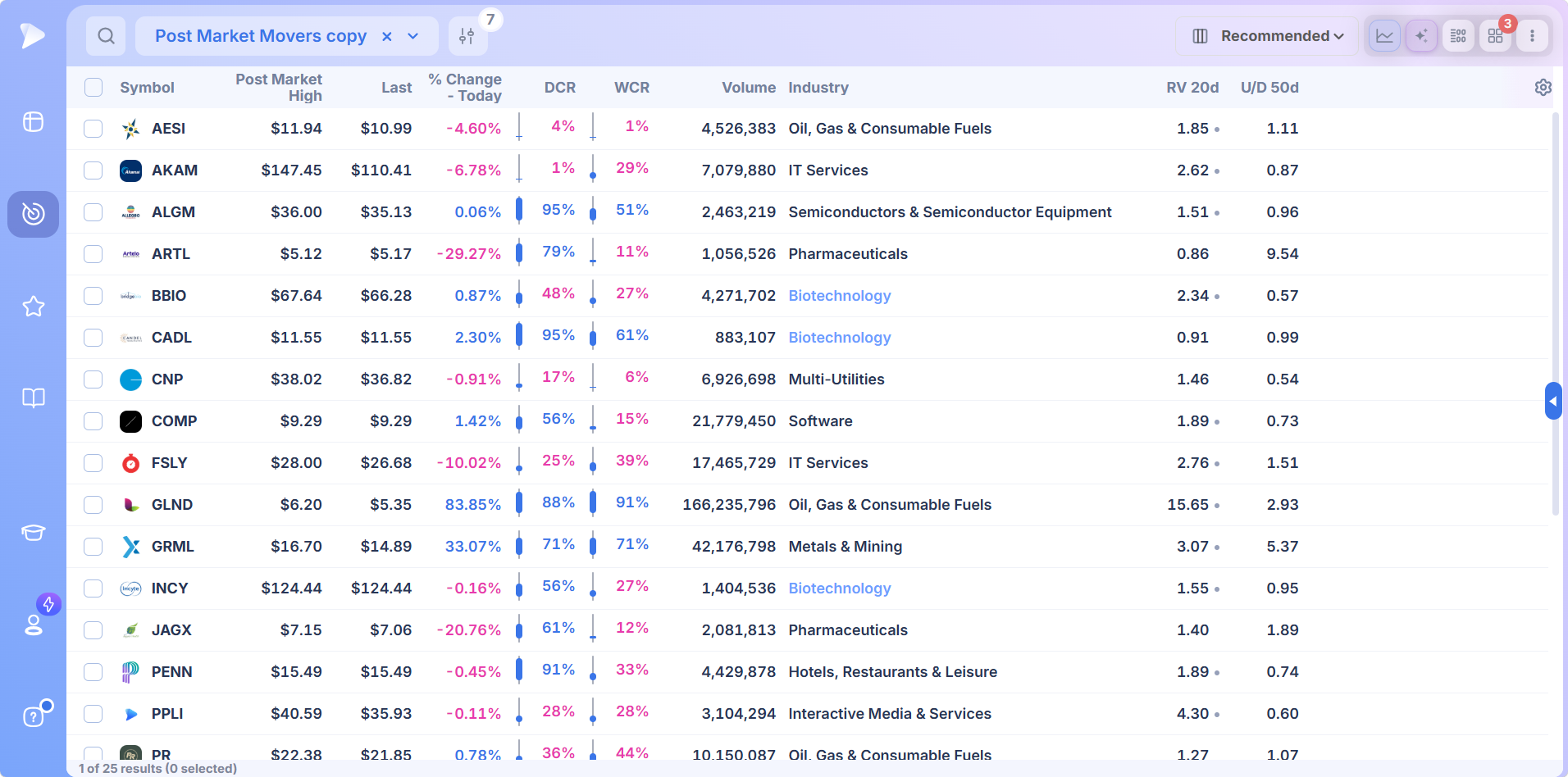
- ✓Post Market Movers opens the evening session in one click, from the same preset library as everything else
- ✓The post market change field runs from the closing price into the evening, so companies reporting at 4:30 surface immediately
- ✓All 24 extended hours fields behave like normal conditions, filtering beside relative strength, growth and leadership
- ✓A dedicated evening column set puts next earnings date, post market volume and gap percent in front
- ✓Most stocks never print after four, so a volume floor does most of the filtering
- ✓$49 a month on a single plan, where MarketSurge charges $149
What Is an After Hours Stock Screener?
A short walkthrough of the evening fields and how each becomes a filter: extended hours data points in Deepvue.
WatchExtended hours data points in DeepvueAn after hours stock screener puts conditions on the window between 4:00pm and roughly 8:00pm Eastern, matched on electronic networks rather than at an exchange. The defining feature is not that it is quiet but that it is lopsided: most listed names never trade, while tonight’s reporters do a full day of business inside ninety minutes.
Movers Lists Rank, Screens Decide
Most people meet the evening through an after hours movers list, and those lists share one flaw: they rank whatever moved, so the biggest after hours movers on any night are usually microcaps on a handful of prints.
An after hours gainers table has the same problem in one direction, a post market movers page in both. Neither can exclude anything, because ranking is all they do. A post market stock screener applies conditions first, so the stock movers after hours reaching your list already cleared a bar you set.
Why Deepvue Is the Best After Hours Stock Screener
Evening work has two halves: reading whatever just moved, and the structural homework that decides tomorrow. On most setups those happen in different places, which is how a twenty minute routine eats an hour. Deepvue collapses them together, and that is the whole case for it as the best after hours stock screener.
The Preset That Opens the Evening
Post Market Movers sits with the other presets under Pre/Post Market, filed beside the morning screen. It is the fastest after hours screener on the platform because somebody already did the thinking.
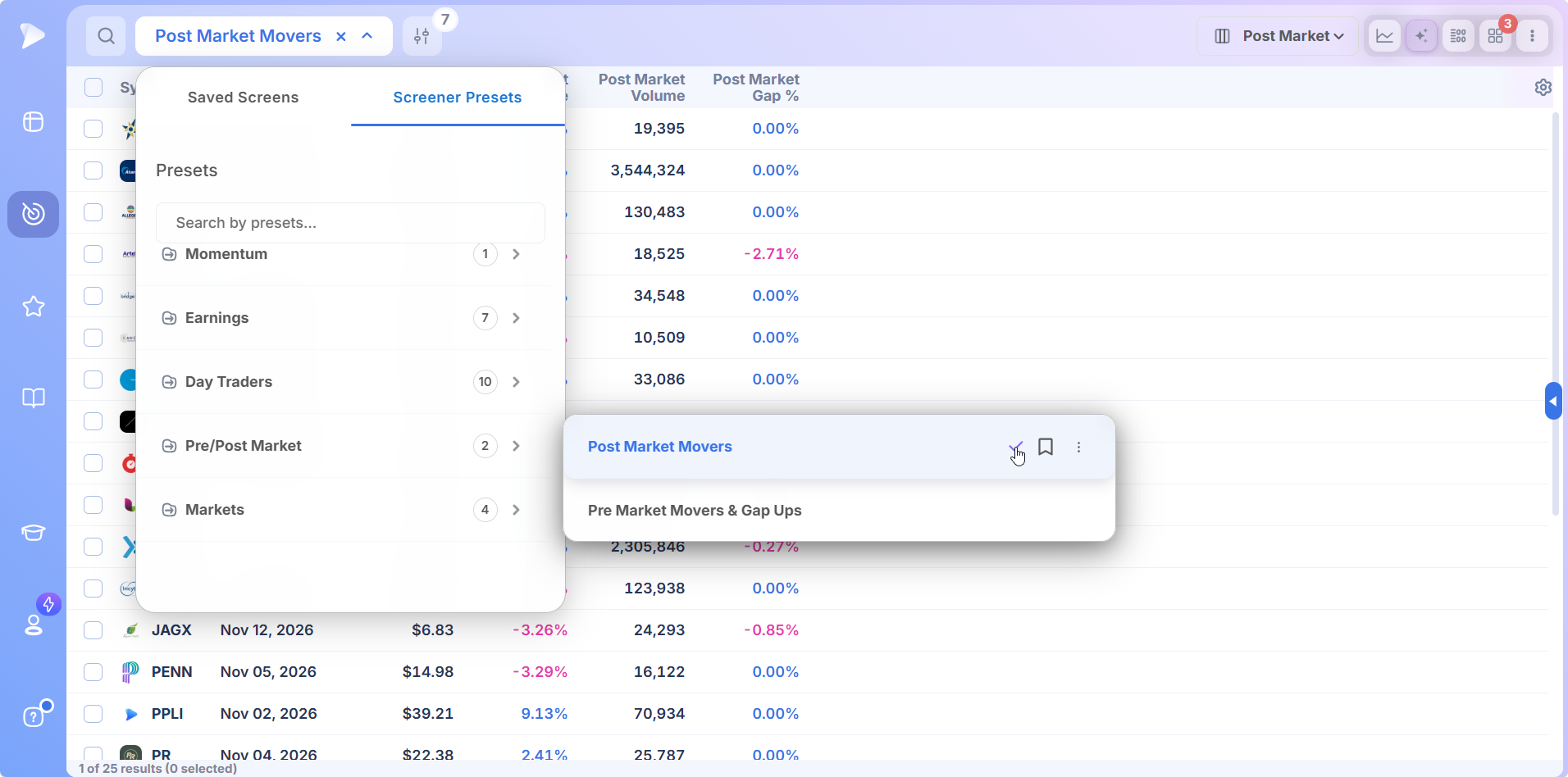
Treat it as a starting point. Duplicate it, tighten the floors, bolt your own structural conditions on top, and it becomes the screen you run nightly without rebuilding it.
The Evening Session, Held in Columns
Post market high, volume, gap percentage and percentage change all sit in the Pre/Post Market category, 24 fields spanning the windows before and after the regular day. Each one filters and sorts beside relative strength and earnings growth.
| Field | What it answers |
|---|---|
| Post Market Price % Change | How far the stock has travelled since today’s close, which surfaces companies reporting right after the bell |
| Post Market Gap % | Whether the move produced a true gap rather than a drift |
| Post Market Volume | How many shares genuinely changed hands after the bell |
| Post Market High | The top of the evening range, and whether the name printed at all |
| Next Earnings Date | When each name reports next, so tonight’s scan doubles as next week’s prep |
| Daily and Weekly Closing Range | Where the stock finished inside its range, today and across the week |
Start with post market price percent change. Its gap counterpart is stricter, since plenty of names travel a long way after the close without producing an actual gap. Group the two under ANY and neither kind of move slips past.
A Table That Changes With the Session
Column sets are saved table layouts, and three of them are filed under Pre/Post Market. One is shaped for the evening, one waits for the morning, and the third is a variation built by a member of the team.
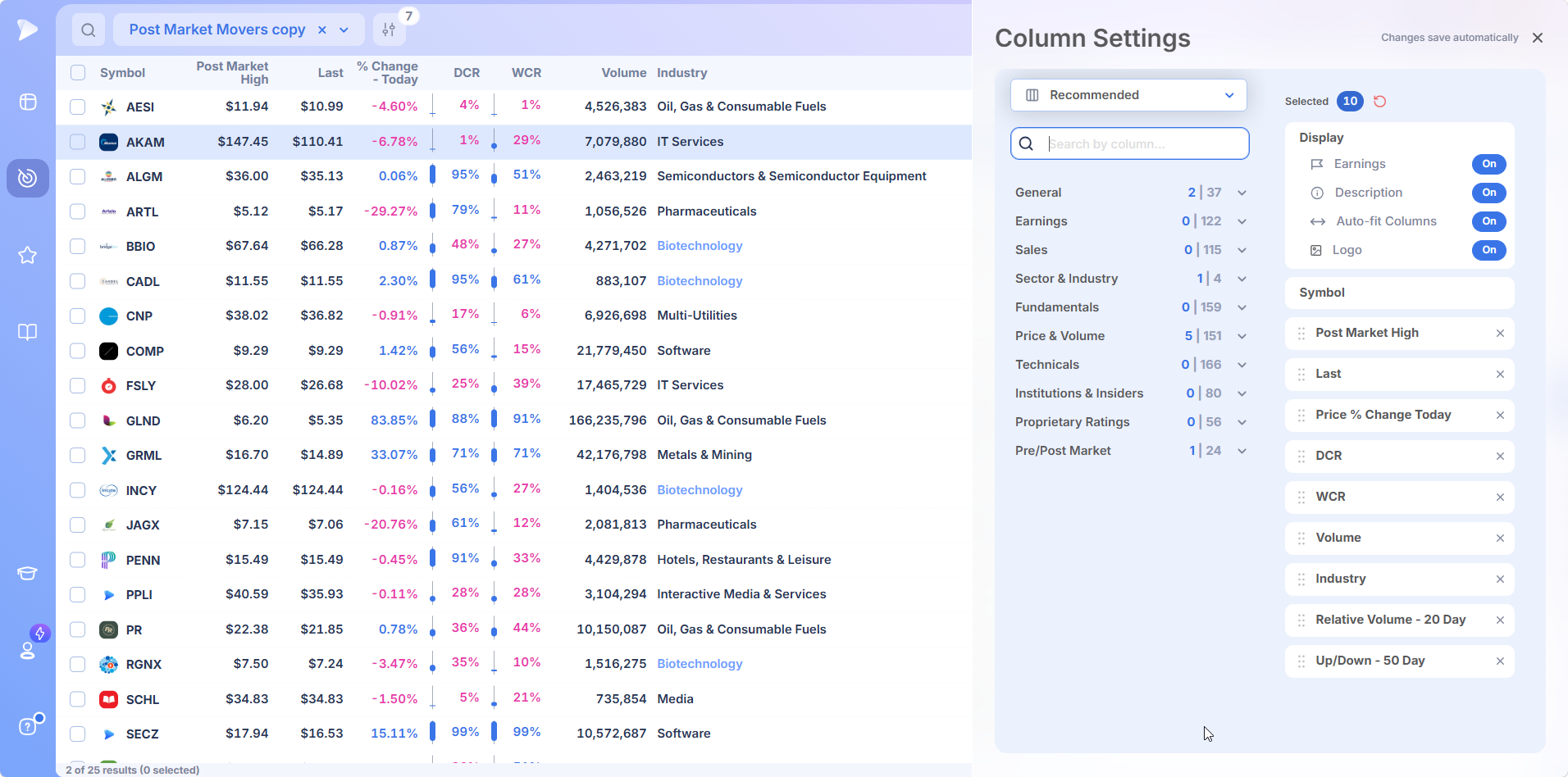
Swapping takes one selection, so the table you read at 4:15 and the one at 9:31 are the same table in different clothes. Built in layouts cannot be edited directly. Duplicate one and the version you shape belongs to you.
The Chart, and the Earnings Record Beneath It
Click any name to bring up its chart alongside the table, drawing tools exactly where you left them. Evening prints can be drawn onto the candles as well, putting the after hours move into the price action itself rather than only the numbers.
WatchWatch how to get extended hours charting in Deepvue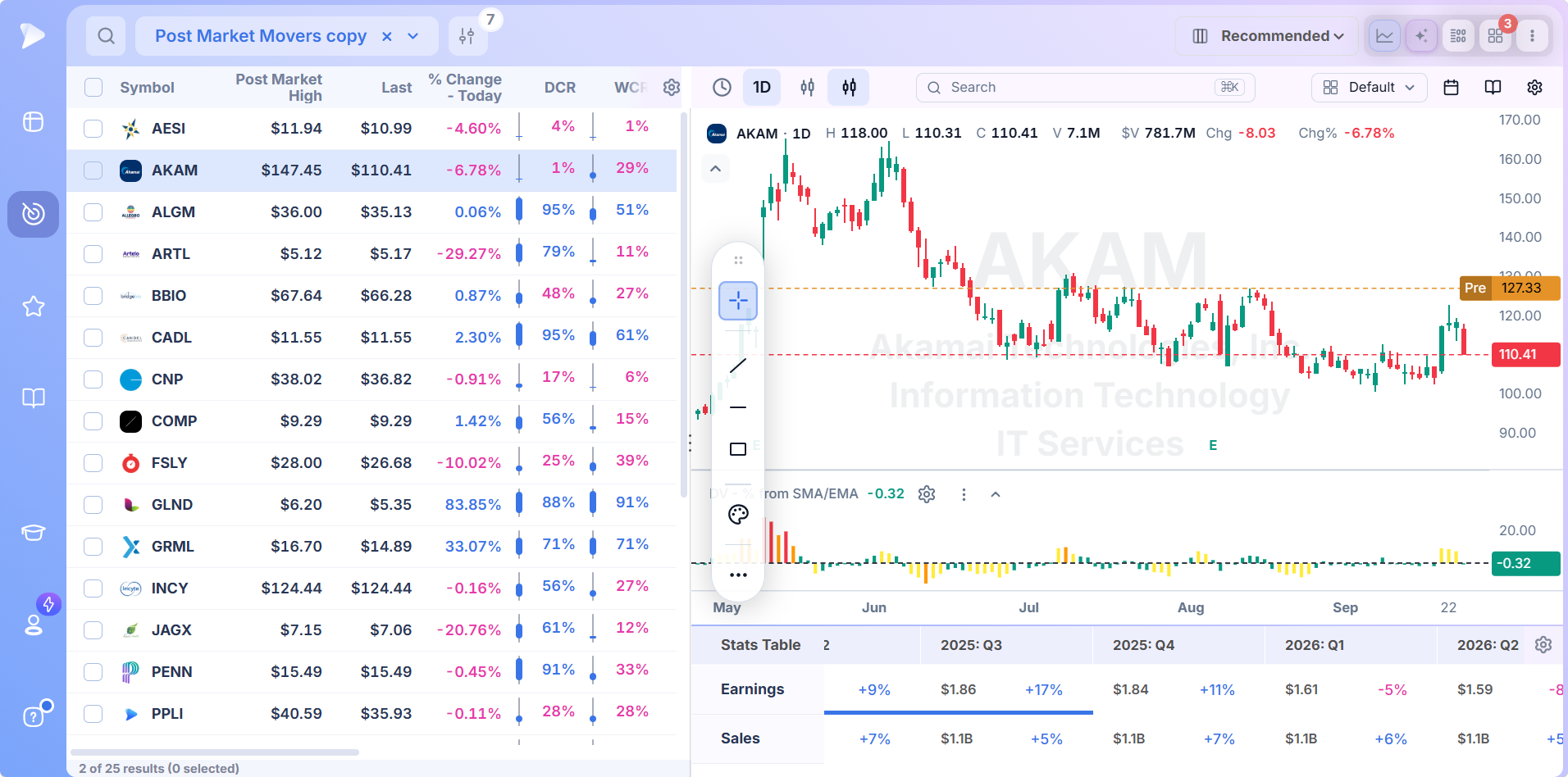
The stats table answers the evening’s real question: does the reaction fit the report? A violent move on a quarter that merely met expectations is a different animal from the same move on a genuine surprise.
Alerts That Carry the List Into Tomorrow
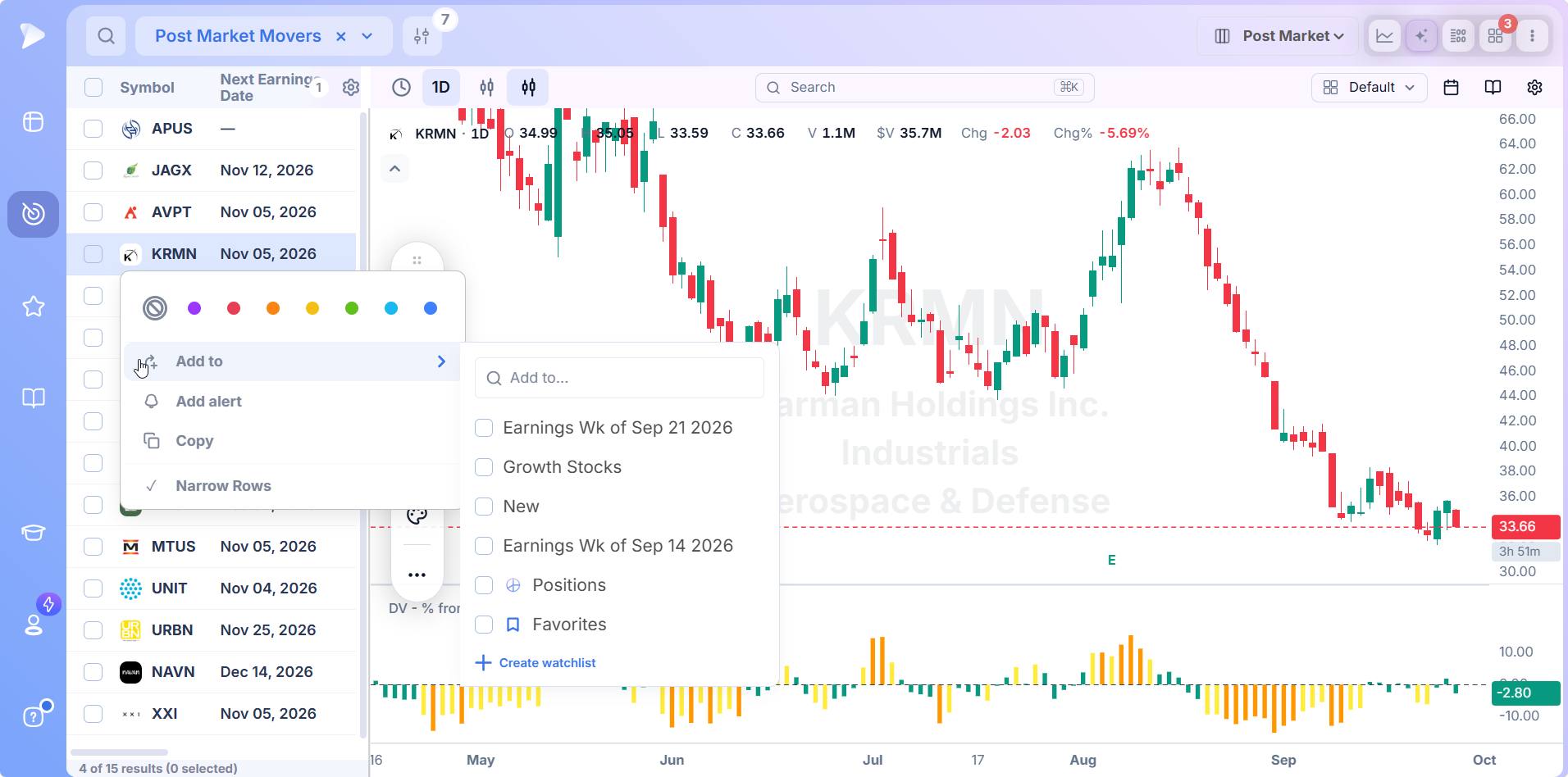
Nothing found tonight matters until the market reopens. Survivors move into a watchlist together, either into a list you already keep or one you spin up on the spot.
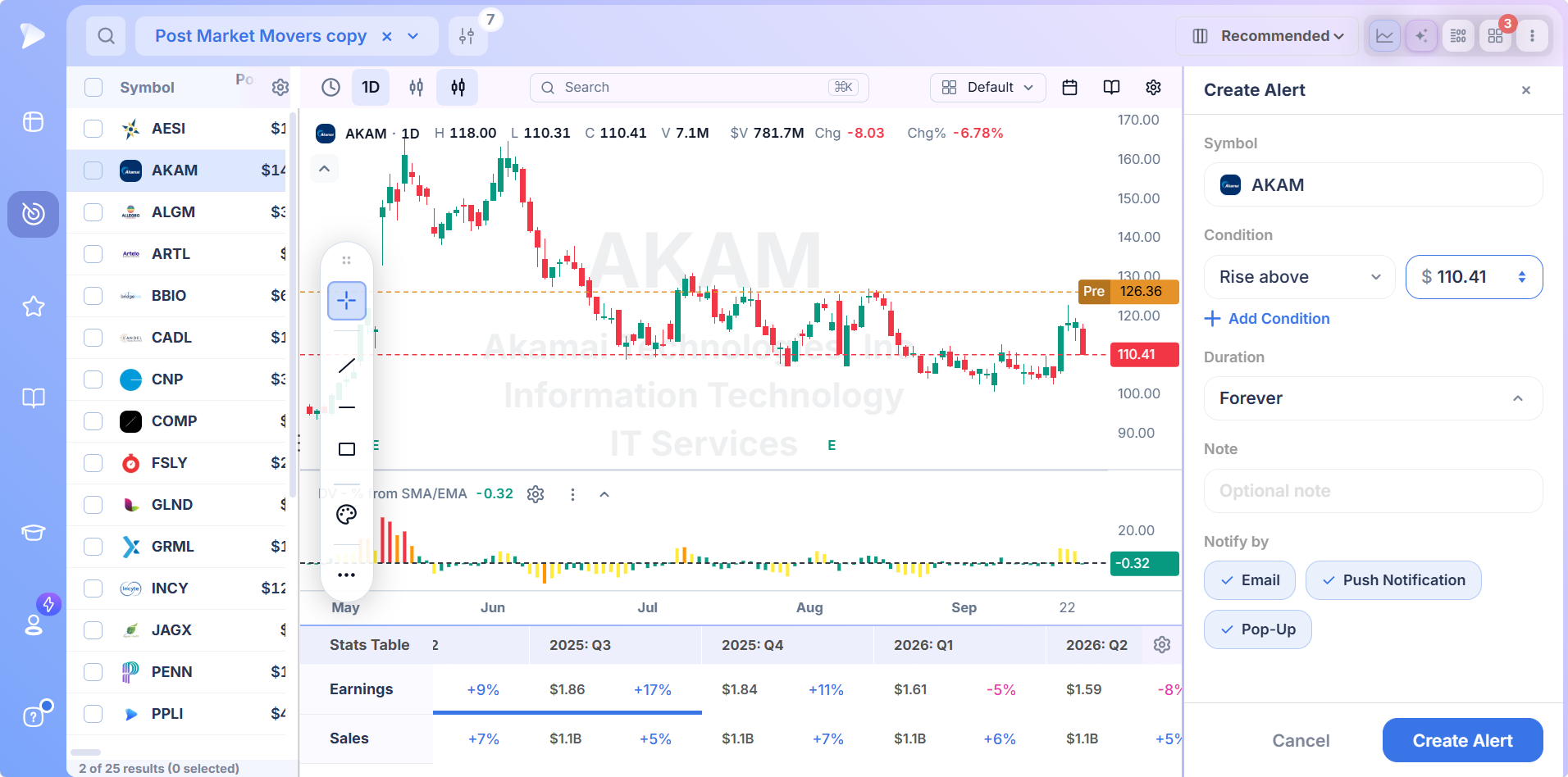
Then an alert goes on the level that decides each name. Add a second condition where the setup calls for it, choose how long it stays armed, write yourself a reminder of the reasoning, and pick how it reaches you.
Why Stocks Move So Hard After the Close
Evening moves come from a handful of causes, and recognizing which one you are looking at is most of the skill.
- •Results and guidance. By far the biggest driver. Results land minutes after the bell and the first reaction is a verdict on the top line figures, reached long before anyone reads the detail.
- •The conference call. An hour or two later, guidance and detail arrive and the evening gets a second opinion. This is where the first reaction is confirmed or quietly dismantled.
- •Company announcements. Deals, buybacks, equity raises and departures at the top are scheduled for a shut market deliberately. Equity raises tend to knock the price hard.
- •Index reshuffles and rulings. Joining or leaving a major index reprices a stock instantly, and drug decisions, study results and agency verdicts habitually land outside market hours.
- •An empty book exaggerating everything. Whichever cause applies, the response has almost nothing to trade against. Trust which way an evening move went. Distrust how far it went.
Most Stocks Do Nothing After 4pm, and That Changes the Screen
Pull up a table after the close and the post market column is mostly blank. Not zero. Blank. Those names never traded at all.
A daytime scan assumes everything has data. An evening scan separates three states: names that moved, names that traded and went nowhere, and names that never printed. The third group is the majority, and a post market volume minimum clears it out in a single condition.
The Second Move Is Usually the Real One
The reaction at 4:05 is a reflex, pricing whatever sat in the first paragraph of the release, set by a small crowd with very little to push against.
Then the call begins, and the figure that governs the next quarter turns up an hour or two after the figure everybody responded to. A stock can be up eight percent at ten past four and flat by six without a single thing going wrong with the report.
So screen twice. An early pass tells you who reported and who reacted. A later pass, once the calls finish, tells you which reactions survived the detail. The second list is shorter and far more trustworthy.
The One Session Where the Numbers Are Finished
There is a quieter case for evening screening that has nothing to do with earnings. Every scan run during the session interrogates a day still being written: the close is not in, the range is not set, volume is partial. Run the identical scan after four and all of it is settled.
Structural work has always been night work in growth trading for this reason. What is basing, extending or losing leadership gets an honest answer only when the candle beneath it is complete, which is why a post market stock market screener pays for itself even on nights when nobody reported.
Running the Nightly Routine With a Post Market Screener
Shape the evening preset around your own criteria. Six steps the first night, one click every night after.
Load Post Market Movers and save a copy, which unlocks the filters for editing.
Put a post market volume minimum in the first group, removing the untraded majority before anything else runs.
Use post market price percent change for the reaction, with the gap condition beside it under ANY.
Bring in the record: relative strength, base position, growth history and the latest reported quarter.
Load the evening column set, then run everything again once the conference calls have wrapped up.
Move what passes into a watchlist and hang alerts on the levels that decide each name at the open.
When typing the request is faster than assembling it, the AI Terminal will build the conditions from a sentence.
What an Evening Print Is Worth
Whatever the evening decides gets revised twice before it counts. The evening price is set by whoever happened to be at their desk. The morning brings slightly more participation. Then the opening auction arrives with the first real depth of the day and produces the number institutions will actually transact at, often some way from where the evening left off.
So treat the evening as the hour for spotting and planning: which reactions look worth following, which of your holdings just changed character, where tomorrow’s decisions sit. The screen exists so nothing important slips by unseen.
Who This After Hours Stock Market Screener Is For
- •Traders doing their market work at night, around a job that was never going to bend around the bell
- •Anyone holding a name that reports this week and wanting the verdict the moment it exists
- •Growth traders whose structural scans need a finished daily candle underneath them
- •Anyone who works earnings season, when those two hours after the bell become the busiest of the quarter
- •Anyone who writes the plan in the evening and executes it against live data the next morning
What Deepvue Users Say
Screening tends to be the reason people stay. One trader on r/CANSLIM, comparing it against everything else on the market, wrote that “there is no better scanner out there than deepvue” for the flexibility it gives.
Pricing
One plan, $49 a month, and the evening tools are simply part of it.
- •Every field and every built in screen, the evening scan and its extended hours conditions among them
- •Charts, dashboards and screen building by description, with ticker research available straight from the row
- •Column sets, watchlists and alerts, so tonight’s layout and tomorrow’s levels are both saved
- •Live data once trading resumes, so the plan written at nine at night is the surface you watch at the open
MarketSurge charges $149 a month.
Joining brings a setup session with the team, an email sequence introducing each module, and weekly webinars that take one area apart at a time.
Tomorrow Gets Decided Tonight
The market gives you two hours when the news is fresh, the data is final and almost nobody is watching. Most traders spend them refreshing a movers list.
Three of the screens here take their shape from the trading day rather than from a setup, and the set is gathered in stock screener by market timing. It covers this session, the live one and the hour before the bell. If setups matter more than the clock, screener by pattern groups the chart formations, screener by indicator holds anything triggered by a signal, and screener by strategy maps the lot.
Start screening after hours tonight
↑ Back to contentsFrequently Asked Questions
How does trading after-hours work?
Trading after-hours works on electronic networks that pair limit orders directly, once the exchanges close. Nobody is obliged to make a market, the crowd is a fraction of its daytime size, and prices step rather than glide. Deepvue treats that session as filterable data rather than a read only quote page.
Can you buy stock after hours?
You can buy stock after hours at almost any brokerage, with conditions attached. After hours stock trading runs on limit orders at most firms, the book is thin enough that fills land well away from the last print, and nothing is guaranteed to execute. Many traders build the list in Deepvue and let the open handle the buying.
Who is allowed to trade after-hours?
Effectively any retail account is allowed to trade after-hours. What used to be institutional territory became standard brokerage furniture long ago, switched on by default or behind one preference. The restrictions that bite are practical: limit orders only, a window that may be shorter than four hours, and no promise of a fill.
Why do stocks spike after-hours?
Stocks spike after-hours because scheduled news is timed for a closed market while the book holding the reaction is nearly empty. Results, deals, offerings, index decisions and regulatory rulings pile into the same few hours. Deepvue’s post market fields separate a move backed by genuine turnover from one built on a few hundred shares.
What happens if I place an order after market hours?
What happens if you place an order after market hours depends on how you tagged it. Unmarked, it queues overnight and joins the opening auction, which can print a long way from last night’s close. Tagged for extended hours, almost always as a limit order, it works immediately and expires with the session.
Where can I see after hours market movers?
You can see after hours market movers on free quote sites, but they rank and nothing more, so the list fills with names you would never trade. Deepvue puts the after hours stock market into the screener itself, so you can demand a volume floor, a price minimum and real structure first.
Is after hours trading a good indicator of the next day?
After hours trading is a good indicator of direction and a poor one of size. The sign of an evening move usually survives to the open because it reflects a real judgment on real news. The size rarely does. Deepvue’s volume ratios tell you which of the two you are holding.
What time does after hours trading end?
After hours trading usually ends at 8:00pm Eastern, four hours past the close, though your broker’s window may be shorter. Activity is heavily front loaded, with most of it arriving in the first hour while reports and calls land. Run the evening preset twice inside that window to catch both waves.
What makes a good post market screener?
A good post market screener does three things: carries extended hours fields that filter and sort rather than sitting on a separate page, judges volume against each stock’s own baseline, and keeps the structural record in the same query. The best post market stock screener does all three without making you switch windows, which is what Deepvue was built for.
Does the evening screener cost extra?
No, the evening screener does not cost extra. There is one price, $49 monthly, with no tiers, upsells or feature gates. Evening fields, presets, saved layouts, charting, lists, alerts and plain language screening all arrive in that single price. MarketSurge charges $149 a month.