The After Hours Stock Screener Built for the Evening Session
The closing bell is a strange kind of ending, because it starts the most information dense stretch of the trading day. The bulk of earnings reports arrive once regular trading stops, guidance gets issued and revised on evening calls, and index committees announce their changes to a closed market. By dinner time, tomorrow has largely been written.
An after hours stock screener is how you read that draft the night it appears. Deepvue’s screening engine pairs a 24 column extended hours category with earnings fields that know who reported and when, all inside 1,152 data points, so the evening’s reactions can be filtered against structure, leadership and the business behind the move. From there the pieces you already use take over: charts beside the table, watchlists for the survivors, alerts for tomorrow’s levels, and a terminal that turns a typed sentence into a screen.
Why Deepvue Is the Best After Hours Stock Screener
Evening screening has two jobs that most tools split across several websites: reading what just moved after the close, and running the structural work that decides tomorrow’s plan. The argument for Deepvue as the best after hours stock screener is that both jobs happen in one table, against one set of conditions, in one sitting.
The Move After the Close, Held in Columns
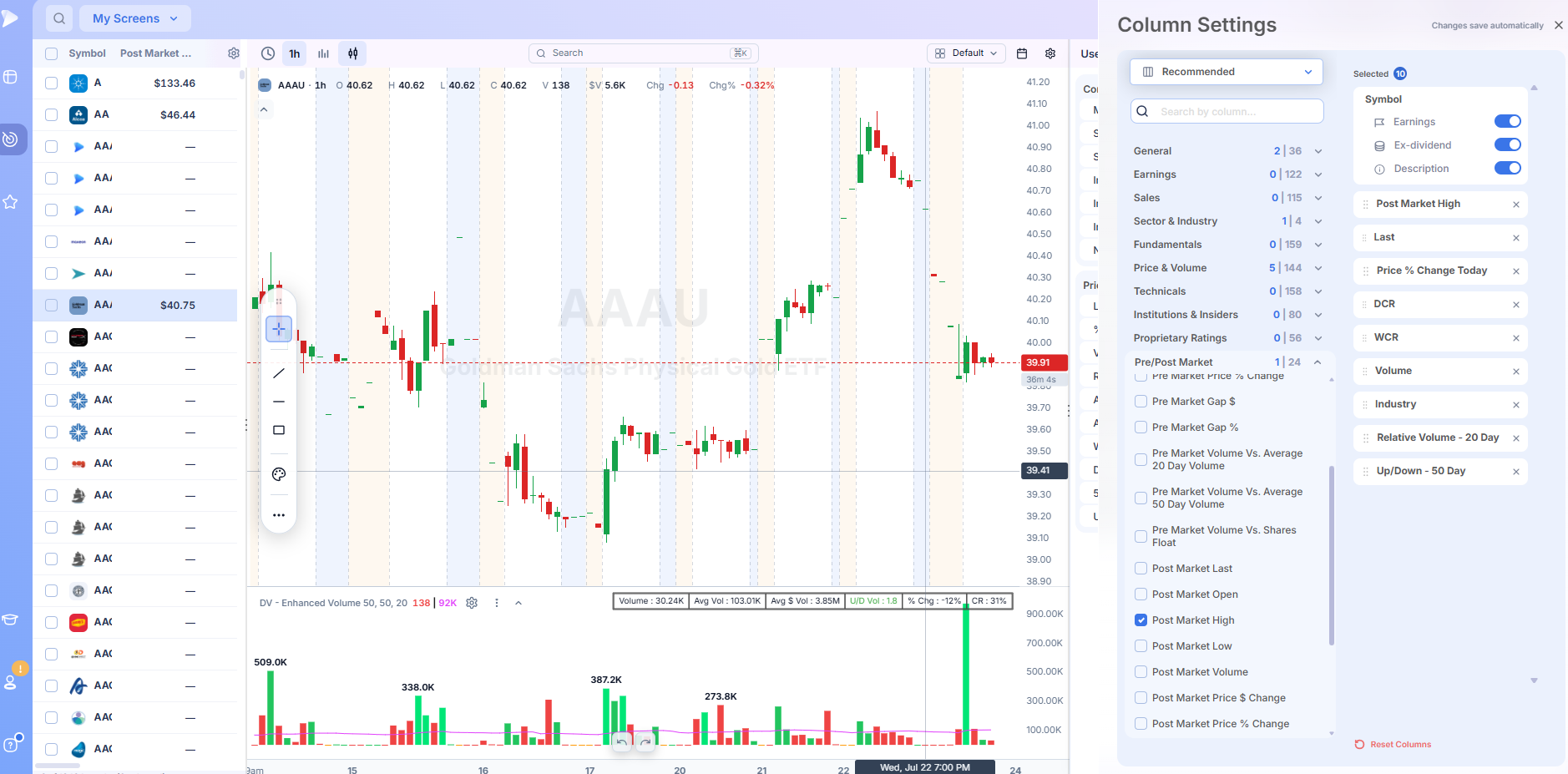
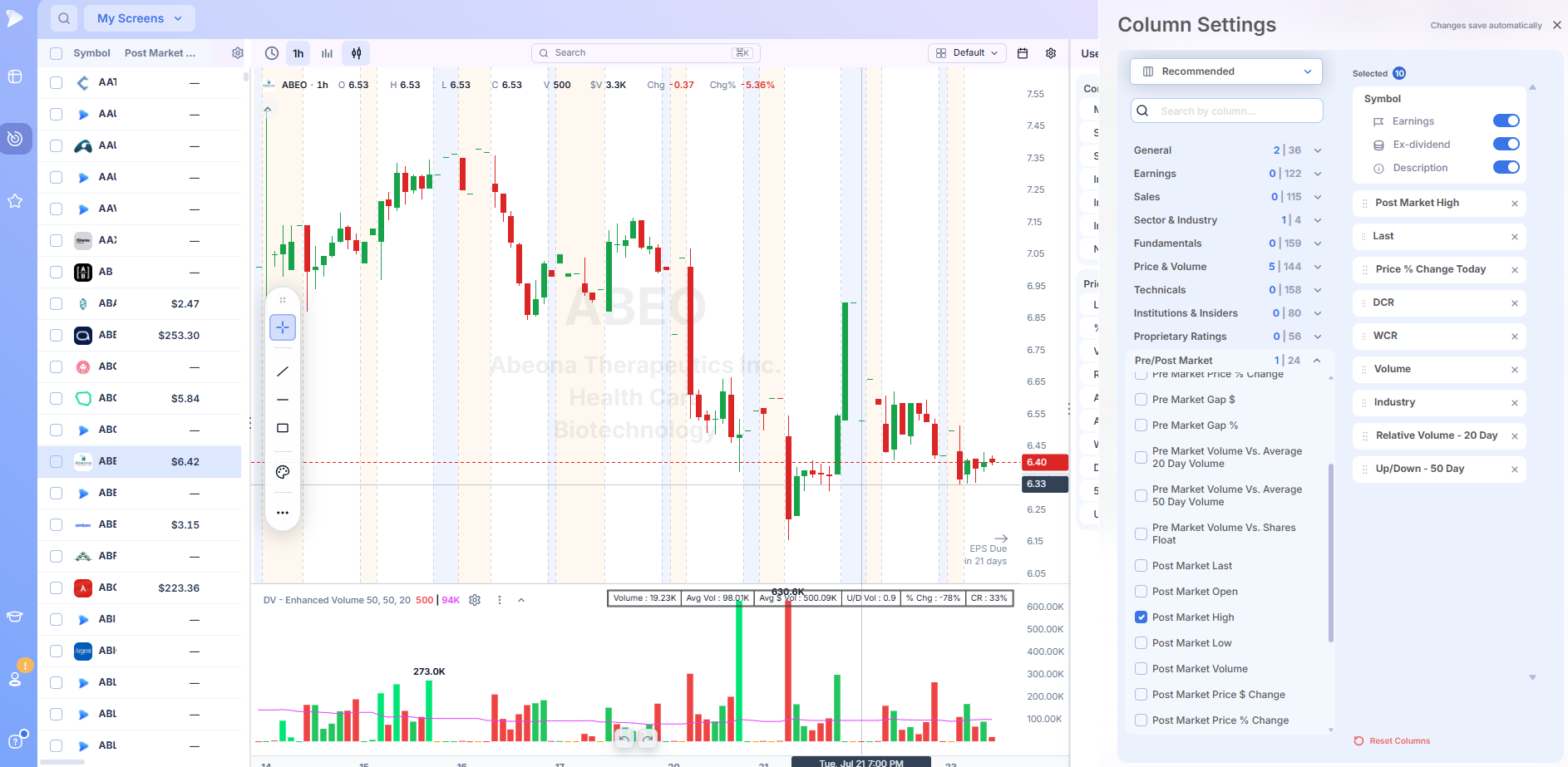
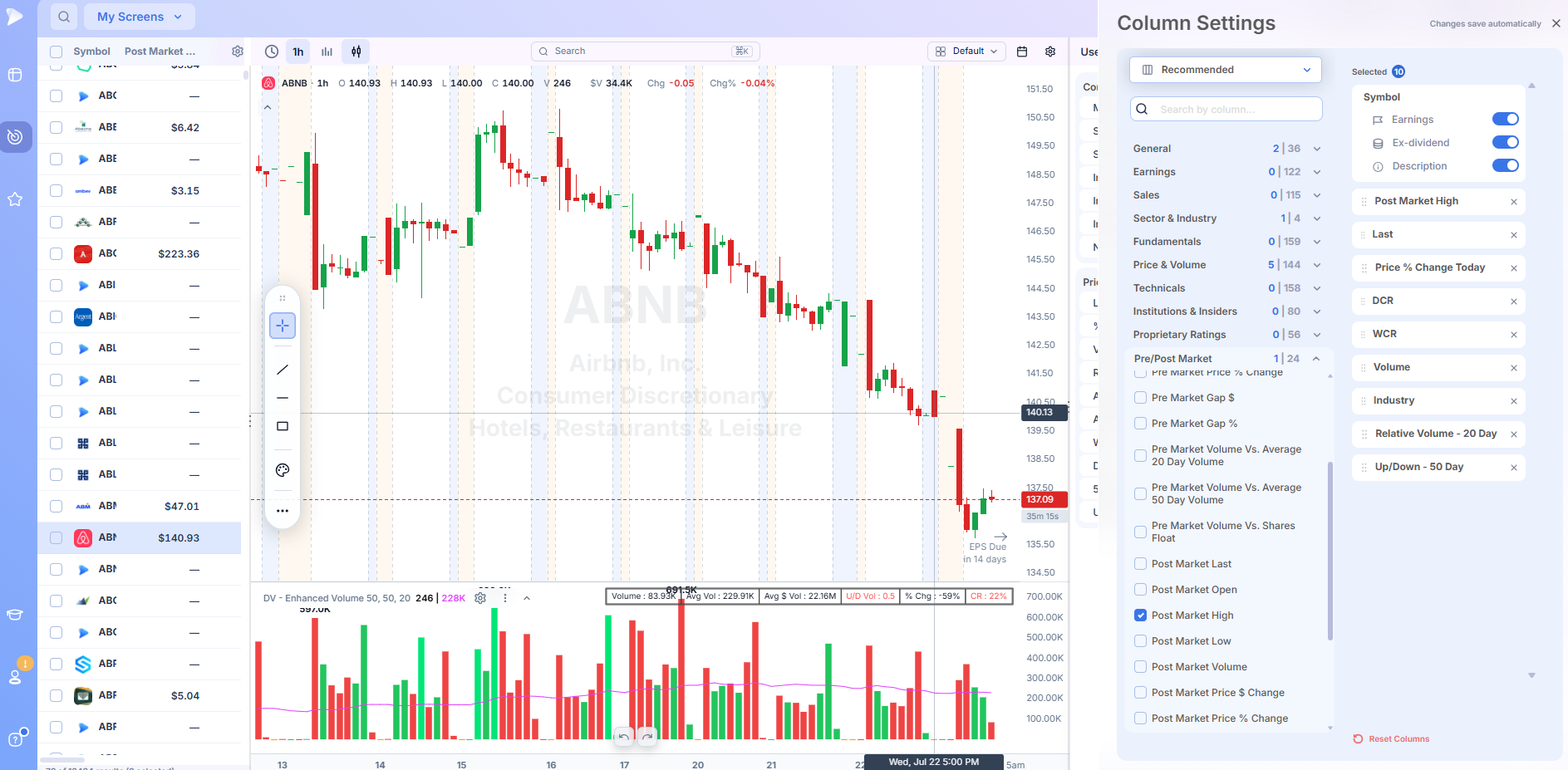
Deepvue’s Pre/Post Market category was built for exactly this window, its 24 columns covering extended hours price action so the evening’s movers surface inside the screener itself rather than on a quotes page elsewhere. Because those columns filter and sort like any other field, an evening reaction can be qualified on arrival: bounded by liquidity floors, sorted by size, and crossed against everything else the platform knows about the name.
Tonight’s Reporters, Filtered Rather Than Googled
Among the 227 earnings fields sits report timing, which turns the evening’s most basic question into a filter: who published after today’s close. Cross that with surprise history, growth trajectory and estimates and the screen separates the reports that changed something from the ones that confirmed what was priced. For anyone holding a position through its own report, this is also the fastest route to the only reaction that matters tonight, the one in your book.
The One Session Where the Data Is Finished
Every screen you run during market hours interrogates a day still being written. Run the same screen in the evening and the inputs are settled: final closes, complete session volume, finished ranges. Nightly screening is the growth trading tradition’s oldest habit precisely because of this, and it is the quiet advantage of the hour. The structural questions, what is basing, what is extending, what is leading, get their most honest answers when the day underneath them is complete.
The Nightly Routine, Preloaded
The screens that belong to the evening are the structural ones, and three ship ready. Mark Minervini – Trend Criteria applies the SEPA alignment of stage, RS and base structure, which is a trend template built to be run on finished daily data. Volatility Contraction, filed under Technical, hunts tight, low ATR bases primed for expansion, the classic overnight homework screen. Deepvue Leaders keeps the leadership list current so tomorrow starts from strength. Fork any of them, bolt on your own thresholds, and the version you save becomes part of the routine.
A Stock Screener After Hours and a Live One at 9:31
The evening’s output does not sit in a notebook waiting to be retyped. Survivors batch into a watchlist, alerts hang on the exact prices where each becomes interesting, and any name opens beside its chart for the closer look. Then the handoff: when regular trading resumes, 568 fields stream live over WebSocket, so the list assembled at 9pm is the surface being watched at 9:31, with the alerts panel doing the watching. The night’s work and the morning’s execution share one table.
Ask the Evening Question in Plain Words
The terminal removes the last bit of friction from a tired hour. Type what you want, names that reported tonight and held their gains, tight bases near highs with big RS, whatever the evening calls for, and it assembles the conditions, runs them and hands back the list. Usage carries no meter, so the fourth rephrasing at 10pm costs the same as the first.
Who This Screener Suits
- ✓Traders whose actual market work happens at night, around a day job the market never respected
- ✓Holders of positions reporting this week who want the after hours verdict the minute it exists
- ✓Growth traders running the classic nightly routine of structural screens on finished daily data
- ✓Earnings season regulars for whom the 4pm to 6pm window is the busiest of the quarter
- ✓Anyone assembling tomorrow’s plan in the evening and executing it against live data in the morning
Pricing
The subscription is $49 a month and it is singular: one plan carrying the extended hours category, the earnings timing fields, the full 1,152 point library, every preset, the builder, the terminal without a meter, plus the surrounding layer of charting, watchlists and alerts.
MarketSurge sits at $149 a month.
What Is an After Hours Stock Screener?
The after hours session runs from 4:00pm to roughly 8:00pm Eastern, electronic trading conducted through ECNs after the exchanges close. Its defining trait is concentration. On an ordinary evening the vast majority of listed stocks barely trade at all, while a small cluster, tonight’s reporters and news names, do a session’s worth of business in an hour. The signal is not spread across the market; it is piled onto a handful of tickers, and everything about screening the session follows from that.
An after hours stock screener finds that cluster and disciplines it. Finding it is trivial, any movers page manages that much. Disciplining it is the work: applying price and liquidity floors so micro caps on stray prints fall away, sizing each move against the stock’s own normal behaviour, and crossing what remains with the structural and fundamental record that decides whether tonight’s move is a candidate or a curiosity.
The evening screen also has a second, quieter mode that the movers pages know nothing about. With the day’s data complete, it is the natural hour for the standing structural screens, the base hunts and leadership checks, run against numbers that will not change under you.
Why Stocks Spike After Hours
The session’s violence has a short list of causes, and knowing the list is most of reading it.
- •Earnings and guidance. The dominant cause by far. Most companies report within an hour of the close, and the initial spike reacts to the headline numbers, often before anyone has read past them.
- •The conference call. The second move of the evening. A stock up eight percent at 4:10 on a headline beat can be down by 5:30 once guidance on the call disappoints, and the reversal is as tradeable a fact as the spike.
- •Corporate announcements. Acquisitions, buybacks, offerings and executive departures cluster after the close deliberately, when the announcing company controls the first read. Offerings in particular produce sharp evening declines, since new shares dilute existing ones.
- •Index changes. Additions to and deletions from major indexes are announced to a closed market, and the affected names reprice immediately as funds that track the index become forced future buyers or sellers.
- •Regulatory and clinical decisions. Drug approvals, trial results and agency rulings frequently land outside market hours, and in the sectors that live on them, the evening move is the move.
- •Thin books amplifying everything. Whatever the cause, after hours liquidity magnifies it. Modest order flow into an empty book produces price changes that overstate the news, which is why the size of an evening spike is the least trustworthy thing about it.
The Evening Print Is a First Draft
An after hours reaction gets rewritten twice before it counts: once in premarket, once at the open, and the honest way to use the session is knowing that sequence.
The 4:05 move is a reflex, priced by a thin crowd off headlines. The call, ending an hour or two later, produces the considered version, and the gap between reflex and considered is where evening reversals live. Overnight, the rest of the world weighs in. Then premarket restates the price with slightly more participation, and the opening auction, the first moment of real depth, delivers the version institutions are actually willing to transact at.
For traders holding across weeks and months, that arc suggests a specific discipline. The evening is for identification and planning: which reactions look like the start of something, which of your holdings just changed character, where tomorrow’s decision points sit. Execution waits for the open, when the price is a price rather than an estimate, and the plan written at 9pm meets volume that can actually confirm or refuse it. The screen’s job tonight is to make sure nothing that mattered went unnoticed, not to trigger anything.
How a Stock Screener After Hours Session Works
Running a stock screener after hours is its own technical problem, and four things separate it from the daytime kind. Handling them is what the tooling is for.
Separating Silence From Stillness
Most stocks print nothing after the close, so absence of movement means nothing and absence of data means less. The screen has to treat the untraded majority as out of scope rather than as unchanged, and liquidity conditions do the sorting: dollar volume floors and price minimums that leave only names where the evening’s prints represent actual participation.
Sizing the Reaction Against the Name
A four percent evening move in a staid large cap and in a young high beta stock are different orders of event, and the flat percentage hides it. Measures that scale each move to its own history, drawn from the platform’s 145 price and volume measures, keep the ranking honest, so the list surfaces genuinely unusual reactions instead of the usual suspects being themselves.
Testing the Move Against the Record
Tonight’s spike sits on top of months of structure and years of financials, and that context is the entire difference between reaction and setup. A name clearing a long base on its report, with the growth history to justify it and leadership already in place, is what the tradition calls an earnings gap worth studying. The same evening percentage in a stock miles below its highs with fading numbers is a headline, not a candidate. Running the structural and fundamental conditions inside the evening screen, rather than checking fifty charts by hand afterwards, is where the hour gets saved.
Grading It at Tomorrow’s Open
The final step happens twelve hours later. The names the evening surfaced either hold their repricing into real volume or give it back, and the list built tonight, parked in a watchlist with alerts on the deciding levels, gets graded automatically as the market reopens. The screen proposes in the evening. The market disposes in the morning, and the workflow is built so you are present for the verdict.
Frequently Asked Questions
How does trading after-hours work?
Between 4:00pm and about 8:00pm Eastern, trading moves from the exchanges to electronic communication networks, systems that match buy and sell limit orders directly against each other. There is no opening auction, no designated liquidity provision, and far fewer participants, so quotes are sparser, spreads run wide, and the price can jump between prints in a way regular hours rarely allow. Brokers route extended hours orders to the ECNs they partner with, executions still print to the consolidated tape, and the mechanics reward patience: the session functions, but it functions like a quiet room where every voice carries further than intended.
Who is allowed to trade after-hours?
Almost anyone with a standard brokerage account. The session began as institutional territory, but extended hours access has been ordinary retail plumbing for years, typically enabled by default or by a settings toggle. The real constraints are practical rather than permission based: most brokers accept only limit orders in the session, some offer narrower windows than the full four hours, fills are never assured, and a few firms have pushed further still toward overnight trading on selected securities. Being allowed in has stopped being the question; the question is whether the execution quality on offer justifies transacting there rather than waiting for the open.
Why do stocks spike after-hours?
Because the evening is when scheduled news concentrates and when liquidity cannot absorb the response. Earnings dominate, with most companies reporting shortly after the close and the first spike reacting to headlines alone, frequently revised an hour later once the conference call reframes them. Acquisitions, share offerings, index inclusion announcements and regulatory decisions also cluster in the window. Underneath every cause sits the amplifier: order books after hours are thin, so buying or selling that regular trading would absorb quietly instead moves the price in jumps, which means the direction of an evening spike is usually informative and its magnitude usually exaggerated.
What happens if I place an order after market hours?
It depends entirely on how the order is designated. A standard order entered in the evening does not execute; it queues until the next regular session and participates in the 9:30 opening auction, which carries real gap risk, since the opening price can sit far from yesterday’s close and a queued market order will take whatever that turns out to be. An order specifically marked for extended hours, which brokers generally require to be a limit order, goes to work on the ECN immediately and lives only as long as the session, expiring or cancelling under the broker’s rules if unfilled. The practical habit that follows: use limits for anything meant to work tonight, and think hard before leaving a market order to meet tomorrow’s auction unattended.